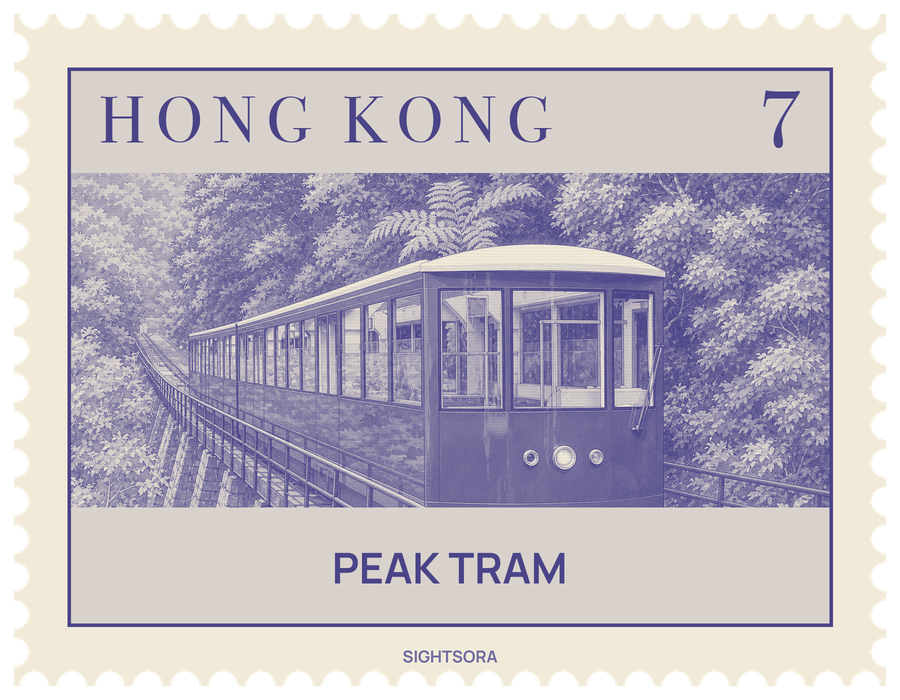
The line is about 1.4 kilometres long and climbs from 27 metres to 396 metres above sea level, with gradients between 4 and 27 degrees, and an average trip takes about five minutes. Along the way the windows look out over the harbour and the towers of the city, and riders as well as residents use it as the most direct way up.
The idea belonged to Alexander Findlay Smith, who petitioned the governor for a concession in 1881 after studying mountain railways across Europe and America. Building started in September 1885, with workers dragging most of the rails and heavy equipment uphill by hand, and on 28 May 1888 Governor Sir George William des Voeux opened the line. A static steam engine pulled the cable at first, and the tram carried 800 passengers on its first day. Its arrival made it practical to live high on the hill, and housing spread across the Peak and the Mid-Levels as a result.
Until 1926 the cars were divided into three classes, with colonial officials and Peak residents in first class, soldiers and police in second, and everyone else, along with animals, in third; from 1908 to 1949 the two front seats were held for the governor under a bronze plaque. In 1926 an electric motor replaced the steam engine. Floods swept away steep stretches of track below Bowen Road, towards Kennedy Road, in 1899 and again on 12 June 1966, and the engine room was damaged in fighting on 11 December 1941, leaving the line idle until 25 December 1945. The Swiss firm Von Roll rebuilt the system in 1989, and after a 14-month closure for a further upgrade it reopened on 27 August 2022 with longer cars carrying 210 passengers each.
Because the two cars balance each other on the same cable, the line is a single track with a passing loop just uphill from May Road, where the rails briefly split into four. There are two marked curves, one to the left just out of the lower terminus and one to the right higher up. Four request stops are named after the roads they serve: Kennedy Road, MacDonnell Road, May Road and Barker Road. Barker Road station, built in 1919, is the oldest station still standing, an open structure of semi-circular arches with classical and Art Deco touches and ornamental ironwork, listed as a Grade I historic building.
Some of the older rolling stock survives. A 1956 aluminium car and a 1989 car sit on a disused spur that once led to the depot near Kennedy Road, another car from the 1956 generation stands near the upper terminus, and a replica of the very first car is shown in the Peak Tram Historical Gallery. At the Central terminus, Lindy Lee's sculpture Eye of Infinity, standing 10 metres tall, was lit up at the opening ceremony of the upgrade on 2 December 2022.
Getting there
The lower terminus is on Garden Road in Central, near St. John's Cathedral; the upper terminus lies beneath the Peak Tower at Victoria Gap.