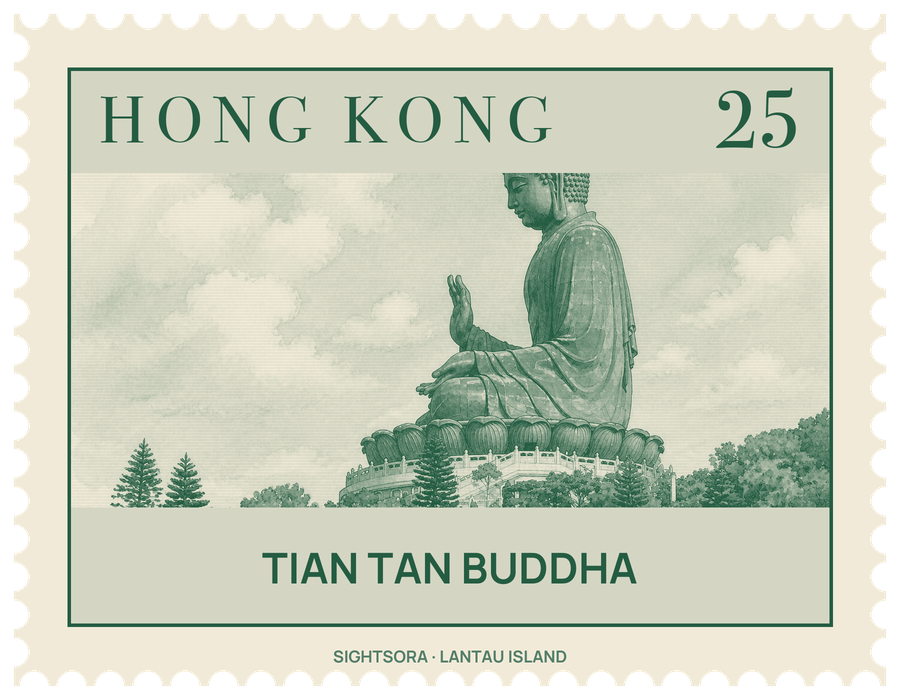
It sits enthroned on a lotus at the top of a three-tier altar, its right hand raised to signify the removal of affliction and its left hand resting open on its lap in a gesture of generosity. Reaching it means climbing 268 steps, although a small winding road also lets vehicles bring visitors with limited mobility up to the statue.
The idea came from Po Lin's monks, whose trips to see two other giant statues, one in Changhua in Taiwan and the Great Buddha of Kamakura in Japan, led to plans starting in 1973; a year later the British government granted a plot of land beside the temple for the project. Work started in 1990 and finished on 29 December 1993, the date on which, by Chinese reckoning, the Buddha attained enlightenment. The opening drew invited monks from many countries, and guests travelled from as far as Sri Lanka, India, Japan and the United States.
The statue weighs over 250 tonnes and was assembled from 202 bronze pieces around an internal steel frame that carries the load. Around it stand six smaller bronze figures, The Offering of the Six Devas, holding out their gifts of music, fruit, ointment, a lamp, incense and flowers. Each gift stands for one of the Six Perfections needed for enlightenment: generosity, morality, patience, zeal, meditation and wisdom.
Beneath the statue are three exhibition floors, each a hall with its own name: Remembrance, Benevolent Merit and the Universe. The best-known object inside is a relic of Gautama Buddha, said to be part of his cremated remains. The Buddha has also appeared on Hong Kong stamps, and the opening scene of the 2003 film Infernal Affairs III was filmed at the statue.
Getting there
One route starts at pier No. 6 of the Outlying Islands piers in Central, with a ferry to Mui Wo, also called Silvermine Bay, then NLB bus No. 2 to Ngong Ping. The other is the MTR to Tung Chung station, then NLB bus No. 23 or the Ngong Ping 360 gondola lift, which takes about 25 minutes to Ngong Ping. Taxis also serve the site.