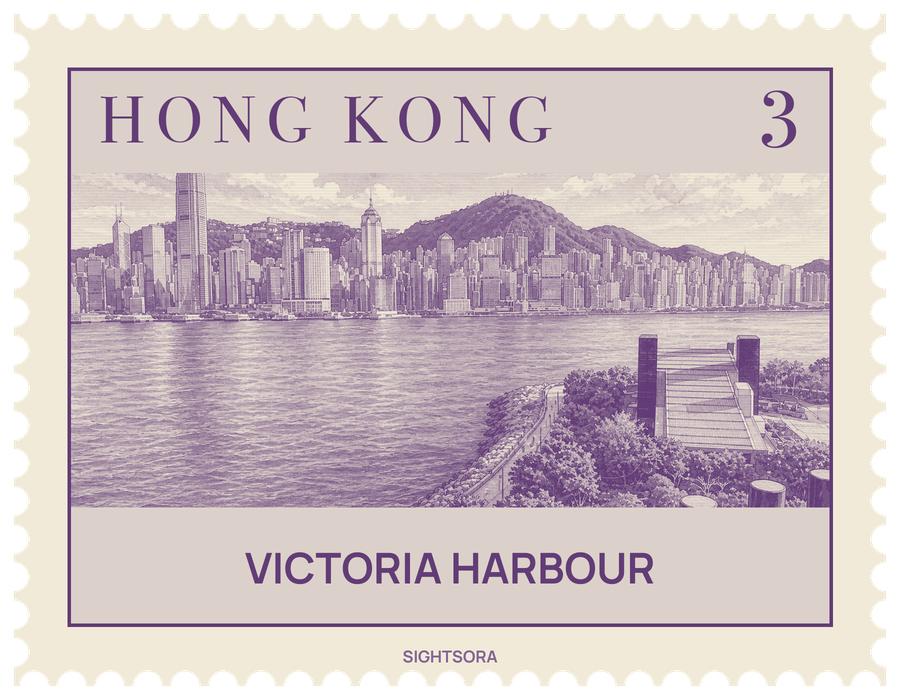
Those deep waters and the harbour's position on the South China Sea were a large part of why Hong Kong became a British colony in 1841 and why it grew into a trading port. The British first called it Hong Kong Harbour and later renamed it after Queen Victoria.
Long before the colony, the harbour appeared on the sailing maps of Zheng He, dated to around 1425 and reproduced in the 17th-century military treatise Wubei Zhi. The first detailed chart was drawn in 1810 for the East India Company by two lieutenants of the Bombay Marine, Daniel Ross and Philip Maughan. In the 1850s members of the Victoria Recreation Club were already holding swimming races and water polo here, until pollution ended the races in 1973.
The shape of the harbour has been changed again and again by reclamation on both sides. Several former islands, among them Stonecutters Island and Kellett Island, are now joined to the mainland or to larger islands, and later projects along the Hong Kong Island waterfront met strong public resistance; reclamation also brought the demolition of two historic landings, Edinburgh Place Ferry Pier and Queen's Pier, despite mass opposition. Campaign groups, the Society for Protection of the Harbour among them, organised to keep the water from shrinking further.
The harbour is best known for its night view, when the skyscrapers of Hong Kong Island stand out against the ridges behind them. Good places to take it in are the Peak Tower on Victoria Peak, the piazza of the Cultural Centre and the Tsim Sha Tsui promenade on the Kowloon side. The Star Ferry, which has been crossing since the late 19th century, offers the view from the water, notably on its route between Central and Tsim Sha Tsui. Each Lunar New Year, on its second night, fireworks are set off over the water, and the government introduced a light show called A Symphony of Lights to draw people to the waterfront.
It is also a working port. Ocean-going ships and river vessels carrying cargo and passengers pass through, and the Kwai Tsing Container Terminals on the western side handle containers around the clock. No bridge spans the harbour: road traffic uses three tunnels, the Cross-Harbour Tunnel of 1972, the Eastern Harbour Crossing of 1989 and the Western Harbour Crossing of 1997, while several Mass Transit Railway lines also run beneath the water.
Getting there
The Star Ferry crosses between Central and Tsim Sha Tsui and between Wan Chai and Tsim Sha Tsui. On the Kowloon side the waterfront promenade at Tsim Sha Tsui and the Cultural Centre piazza face Hong Kong Island; from the island side the Peak Tower looks down over the whole harbour.