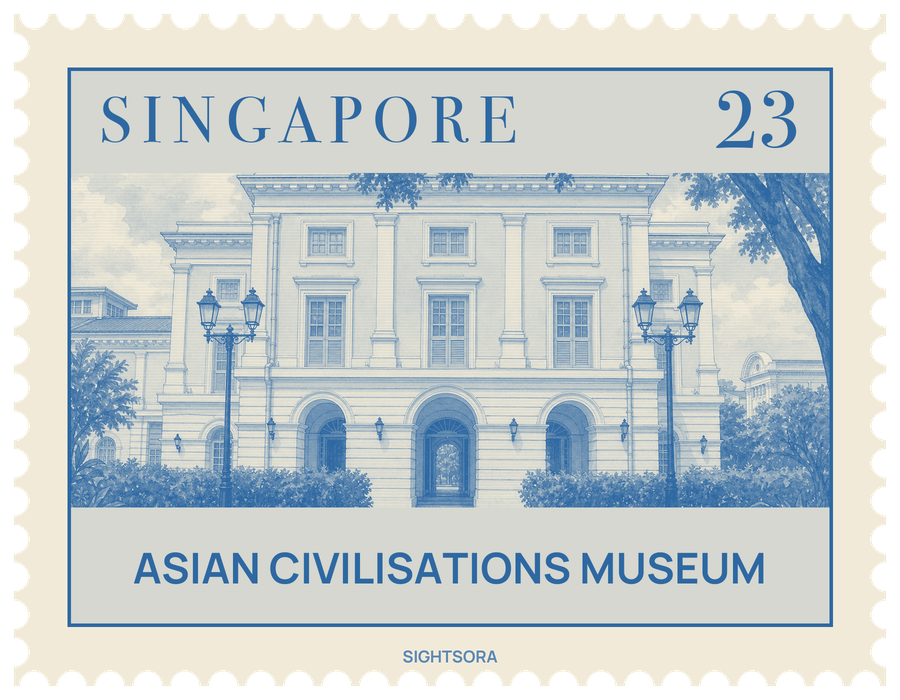
It is one of a group of four Singapore museums, its partners being the Singapore Art Museum, the Peranakan Museum and the National Museum of Singapore, and it was among the first in the region to take all of Asia as its subject.
The museum began in 1997 in the Old Tao Nan School building on Armenian Street, where its displays centred on Chinese civilisation. When it moved its main home to Empress Place in 2003, the collection widened quickly to the rest of the continent, and the original Armenian Street building was later turned into the Peranakan Museum. The galleries at Empress Place were reworked in phases from 2014, with the first new spaces shown in November 2015.
The best-known holding is the cargo of the Tang Shipwreck, kept permanently in the Khoo Teck Puat Gallery. The ship was a 9th-century trader sailing for Iran and Iraq that went down off Belitung Island in the Java Sea and was found in 1998; from it came more than 60,000 Chinese ceramics of the Tang dynasty, many in very good condition, together with pieces in gold and silver.
Elsewhere, the Chinese collection takes in Dehua porcelain figures, Taoist and Buddhist statues, export porcelain and calligraphy. The South Asian galleries show sculpture across many periods, among them Chola bronzes such as a figure of Uma, consort of Shiva, and early Buddhist sculpture of the Gandhara and Mathura schools, among it a Gandharan Bodhisattva head and a sandstone Mathura Buddha of the Kanishka era; South Indian woodwork, Nepali-Tibetan bronzes, miniatures and colonial prints fill out the section. The Southeast Asian collections are wide and rich in ethnographic material, from Khmer and Javanese temple sculpture to later Buddhist art of Burma and Thailand and Sinicised temple art from Vietnam, as well as Peranakan gold, textiles, tribal ornaments and theatre masks. Some rooms are set aside for temporary exhibitions.