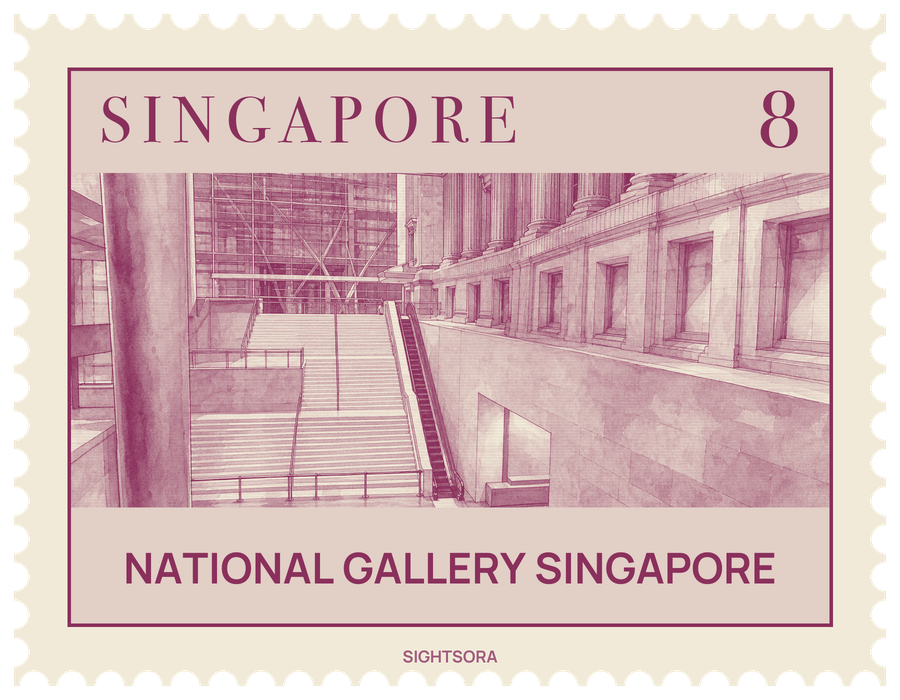
Its collection of more than 9,000 works runs from the 19th century to the present, and its doors opened on 24 November 2015, ten years after Prime Minister Lee Hsien Loong first proposed the conversion in 2005.
The two buildings carry much of Singapore's modern history. City Hall, built between 1926 and 1929 as the Municipal Building, faces the Padang with 18 Corinthian columns three storeys high. In it, Admiral Lord Louis Mountbatten accepted the Japanese surrender on 12 September 1945, and in 1959 Lee Kuan Yew and his Cabinet took their oaths of office in the City Hall Chamber. The former Supreme Court, declared open in 1939 on the site of the Grand Hotel de l'Europe, is arranged around a central rotunda whose dome once covered a circular law library; its columns, sculptures and relief panels are the work of the Italian artist Cavaliere Rudolfo Nolli.
The French firm Studio Milou won an international design competition and, with CPG Consultants, linked the two buildings under a draped canopy held up by tree-like columns at roof level. Because both are national monuments, the façades, the Surrender Chamber, the office of Lee Kuan Yew and the panelling of four rooms in the Supreme Court had to be kept as they were.
The displays draw mainly on Singapore's National Collection, which began with a bequest of 93 works from the cinema magnate Dato Loke Wan Tho. The DBS Singapore Gallery traces the art history of Singapore from the 19th century to the present, with artists such as Georgette Chen, Cheong Soo Pieng and Liu Kang, while the Southeast Asia Gallery in the former Supreme Court follows the region's art from the 19th century, including figures such as Raden Saleh, Affandi, Le Pho and Fernando Cueto Amorsolo. Further spaces host touring exhibitions, and the Keppel Centre for Art Education offers hands-on art for children and families.