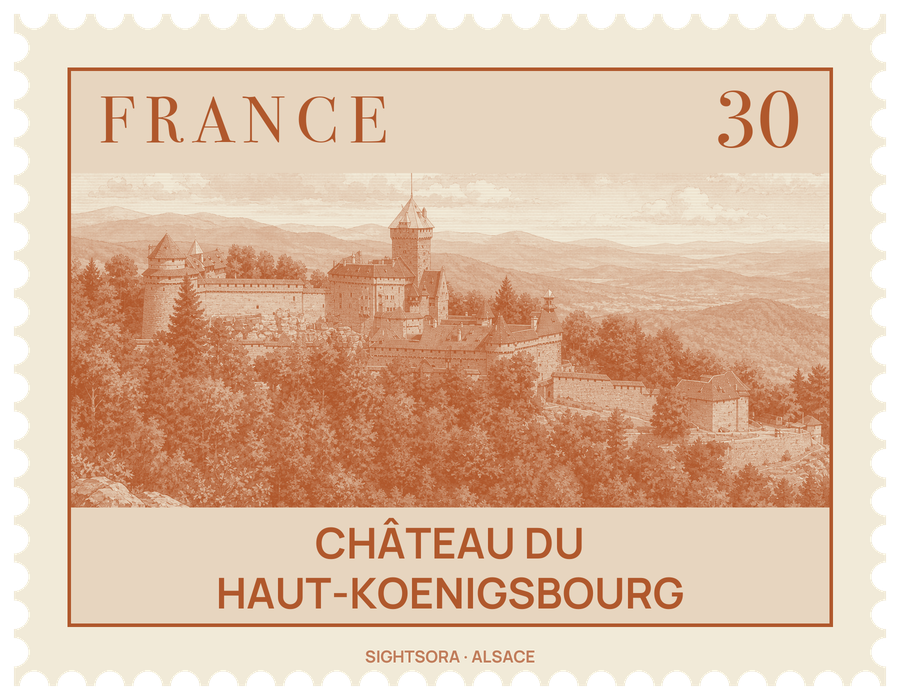
What visitors walk through today is largely a reconstruction: between 1900 and 1908 the German emperor Wilhelm II had the ruined castle rebuilt, and the result says as much about his own ideas of the past as about the Middle Ages.
The rock is first recorded in a deed of Charlemagne in 774 under the name Stofenberk. A Hohenstaufen castle stood here by 1147, and by 1192 it was being called the Königsburg, the "King's Castle". Later holders let robber barons use it as a hideout, and in 1462 the combined forces of Colmar, Strasbourg and Basel set it on fire. The Counts of Thierstein rebuilt it after 1479 with defences adapted to the artillery of their day, but in 1633, during the Thirty Years' War, Swedish troops took it after a 52-day siege, burned and looted it, and the ruins were left to the forest for centuries.
After 1871 Alsace became part of the German Empire, and in 1899 the town of Sélestat, which had bought the ruins, handed them to Wilhelm II. He wanted a monument to medieval Alsace and to German civilisation, and he hoped it would tie Alsatians more closely to the new empire. The architect Bodo Ebhardt studied the surviving walls, archives and castles of the same period and aimed to show the castle in the state it had reached just before the siege of 1633 ruined it, and the emperor inaugurated it on 13 May 1908 with a costumed procession in pouring rain.
Where documents ran out, Ebhardt improvised, and Wilhelm pushed for touches of Romantic nostalgia. The keep is now thought to be about 14 metres taller than the original, the roof over the main dining hall was raised above its historic height, and the decoration plays up the ties of the Habsburg emperors to the Hohenzollern family. For years French opinion dismissed the castle as a fairy-tale piece of German propaganda; historians have since come to value it as evidence of Wilhelm II's romantic nationalism and of Ebhardt's work.
France took the castle over after the 1919 Treaty of Versailles, and it has been a protected monument historique since 1862. Jean Renoir shot parts of La Grande Illusion here in 1937. Just below it lies the ruin of the Château de l'Oedenbourg, also called Petit-Koenigsbourg, a historic monument in its own right. The castle offers visits adapted for people with reduced mobility and for visitors with visual, hearing or intellectual disabilities.