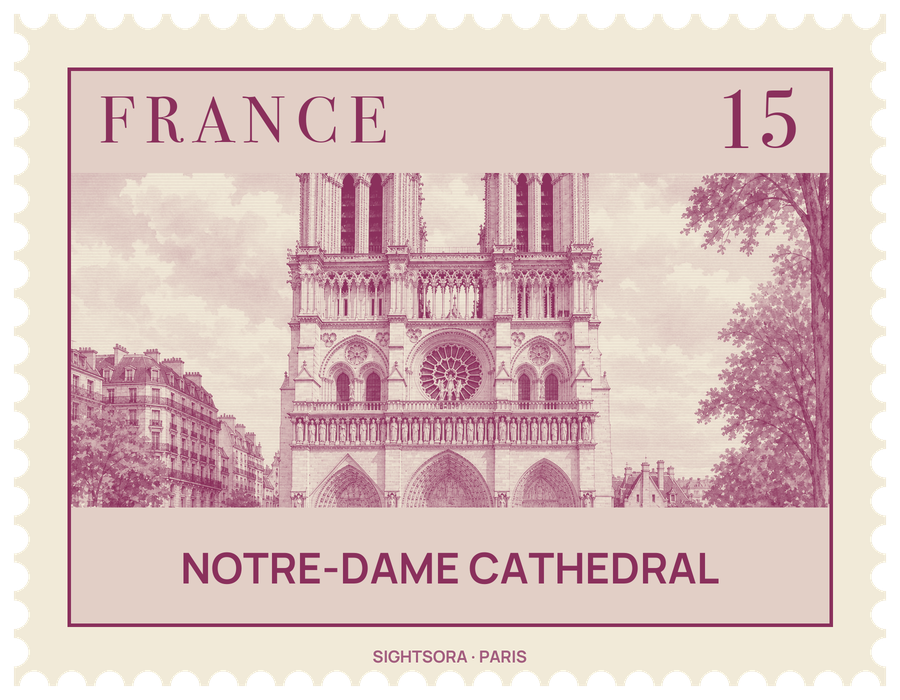
Dedicated to the Virgin Mary, the Gothic cathedral is the seat of the archbishop of Paris. Bishop Maurice de Sully began it in 1163, and the bulk of the building was finished by 1260, though later centuries kept changing it.
The cathedral is known for its early use of rib vaults and flying buttresses, which let the walls rise higher and thinner and hold far larger windows. Its three rose windows are the clearest result. The west rose above the portals, from about 1225, is the smallest at 9.6 metres across, and its glass was remade in the 19th century. The two transept roses came later and are larger; the south rose, a gift of Louis IX, measures 12.9 metres and is arranged in four circles of medallions with the apostles, martyrs, virgins and angels, and still mixes medieval and 19th-century glass.
The west façade was meant to be read like a book of pictures by a congregation that mostly could not read. The central portal shows the Last Judgment, with souls being weighed and the damned led away; the Virgin is crowned over the right-hand door, and the left-hand door is given to saints important to Paris, among them Saint Anne. Higher up, gargoyles added around 1240 throw rainwater clear of the walls, and chimeras and other monsters watch over the city from the Galerie des Chimères. Many of these figures were lost in the 17th and 18th centuries or smashed in the Revolution, when the twenty-eight statues of biblical kings were beheaded; Viollet-le-Duc replaced them in the 19th century, and many of the original heads, dug up nearby in 1977, are shown at the Musée de Cluny.
The building has lived through a great deal. Revolutionaries turned it into a Temple of Reason in 1793; on 2 December 1804 Napoleon crowned himself Emperor inside. Neglect followed until Victor Hugo's 1831 novel Notre-Dame de Paris (The Hunchback of Notre-Dame) stirred public concern, and from 1844 the architects Viollet-le-Duc and Lassus led a long restoration that added a new spire and the chimeras. On 15 April 2019 a fire destroyed the spire and the oak "forest" of roof beams, but firefighters saved the façade, towers, walls and stained glass; the cathedral reopened in December 2024, with a new spire and a gilded cockerel on top.
Inside, the cathedral holds Gothic, Baroque and 19th-century sculpture, altarpieces of the 17th and early 18th centuries, and relics including the crown of thorns, which Louis IX placed here and which returned to the cathedral on 13 December 2024. The great organ in the west end has more than 8,000 pipes and survived the fire with little damage. Ten bells hang in the towers, the two largest, Emmanuel and Marie, in the south tower. A stairway of 387 steps climbs the south tower, pausing at a Gothic hall level with the rose window. On the square in front, a marker on the ground has served since 1924 as Point Zéro of the French road system.