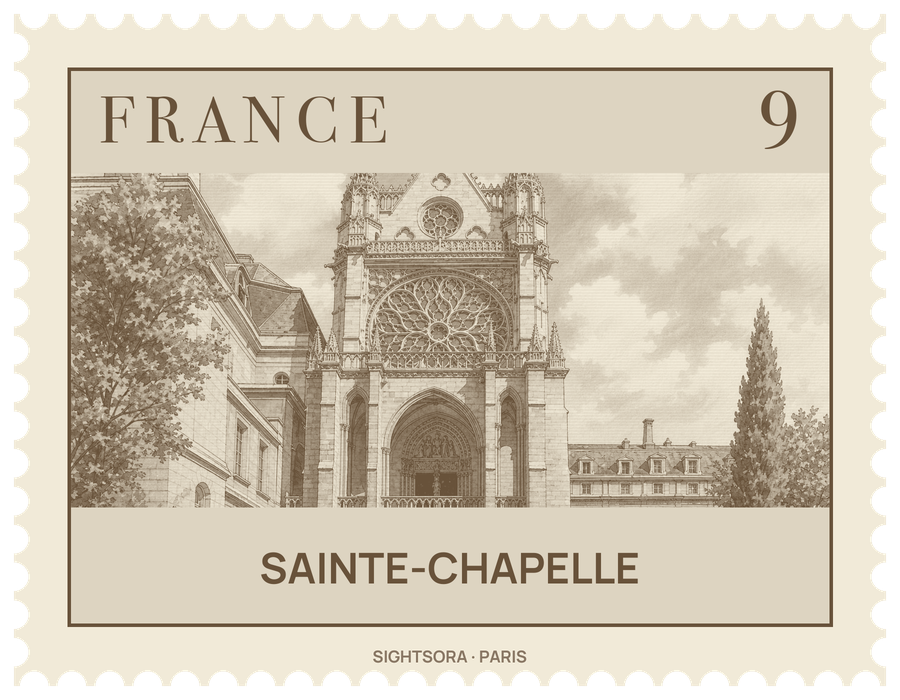
It belonged to the medieval Palais de la Cité, home of the French kings until the 14th century, and together with the Conciergerie next door it is a rare survivor of that Capetian palace. The chapel was consecrated on 26 April 1248 and is a textbook piece of Rayonnant Gothic, the phase of the style that chased lightness and height.
Louis bought the crown from Baldwin II, the Latin emperor in Constantinople, for 135,000 livres, money that went to the Venetians holding it as a pledge; the crown reached Paris in August 1239, and the king carried it on the last stretch himself, barefoot. A silver reliquary chest for the relics cost him 100,000 livres, while the chapel itself, glass included, came to 40,000. The building was planned on two floors of equal size: the upper one for the royal family, their guests and the relics, the lower one for the palace staff: soldiers, servants and courtiers.
The Revolution hit hard. The chapel became a grain store, the outside sculpture and royal emblems were smashed, the spire came down and the reliquaries were melted for their metal; the Crown of Thorns survived and went to the treasury of Notre-Dame. From 1840 a restoration lasting twenty-eight years, begun under Félix Duban and carried on by Jean-Baptiste Lassus and Émile Boeswillwald, Viollet-le-Duc among the assistants, brought back the medieval look. The cedar spire on the roof, thirty-three metres high, is the fifth on the site and dates from that campaign.
Visitors enter the lower chapel first, a low space dedicated to the Virgin Mary, only 6.6 metres high, its columns painted with Louis IX's fleur-de-lys and the castle of his mother, Blanche of Castile. Narrow stairs in the towers lead up to the upper chapel, where the masonry almost disappears and the walls become glass: about 670 square metres of it, not counting the rose window. Fifteen tall windows from the mid-13th century fill the nave and apse with deep blues and reds; the Centre des monuments nationaux, which runs the chapel, counts 1113 stained-glass panels in all.
The windows tell a story in order. The three in the apse show the New Testament, with the Passion at the centre, while the nave windows run clockwise from Genesis on the north wall through Exodus, Judges, Esther and David to the Book of Kings; the last window on the south wall shows the relics arriving in Paris in the hands of King Louis. At the west end, the rose window was added in the late 15th century in the Flamboyant style: nine metres across, its eighty-nine panels picture the Apocalypse. Two small alcoves on either side of the nave mark where the king and queen sat during services.