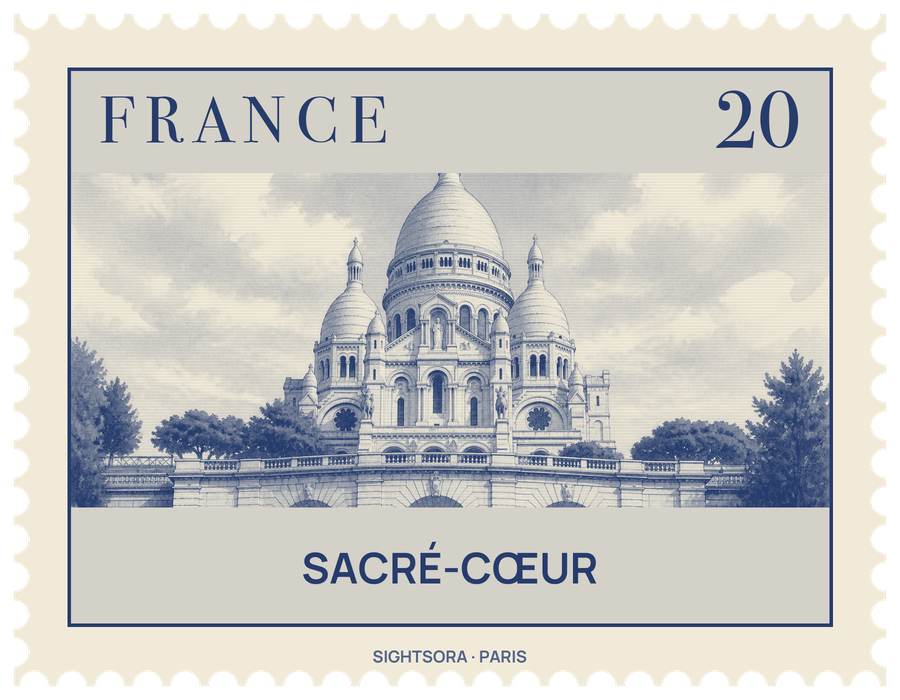
The Catholic basilica, built between 1875 and 1914 and consecrated in 1919, honours the Sacred Heart of Jesus, and adoration of the Eucharist has gone on here day and night without a break since 1 August 1885. The hill is traditionally linked with the martyrdom of Saint Denis, patron saint of Paris.
The church was proposed in 1870 by Felix Fournier, bishop of Nantes, after France's defeat at Sedan in the Franco-Prussian War, which he blamed on the country's moral decline; the money came entirely from private donors. Because the hilltop looks down on the scene of the Paris Commune and building began only after the Commune was crushed, the basilica has drawn criticism from parts of the French left ever since. Paul Abadie's design won a competition of seventy-seven entries, but the unstable hill first had to be propped up with eighty-three shafts, each thirty meters deep, filled with rock and concrete. Abadie died soon after the foundations were finished in 1884, and a series of architects carried the work on.
The style is a free take on Romano-Byzantine architecture: a tall, elongated central cupola ringed by four smaller domes, with the bell tower at the north end. The stone is a Chateau-Landon travertine from Souppes-sur-Loing, which gives off calcite when rain falls on it and so stays white. Over the main entrance on the south side, a statue of the Sacred Heart of Christ stands above bronze equestrian figures of Joan of Arc and Saint Louis by Hippolyte Lefèbvre. The tower holds the Savoyarde, a great bell cast in Annecy and given by the four dioceses of Savoy, which rings only on major feast days.
Inside, the interior is kept dim by windows set high above the altar, and the eye goes straight to the mosaic over the choir, known as the Triumph of the Sacred Heart and dedicated in 1923. Christ in white opens his arms to show a golden heart, with the Virgin Mary, the Archangel Michael and a kneeling Joan of Arc around him. Chapels line the nave and apse, many of them given by professions or religious orders and decorated to match, and the crypt below, unusually, is lit by daylight through a trench dug around it. Visitors can climb to the top of the dome for a panoramic view of the city.
Getting there
Anvers station on Métro line 2 is the closest stop, and buses also serve the basilica.