The Musée de l'Orangerie pairs that cycle with a collection of Impressionist and Post-Impressionist painting, with works by Cézanne, Matisse, Modigliani, Picasso, Renoir, Henri Rousseau, Sisley, Soutine and Utrillo, among others.
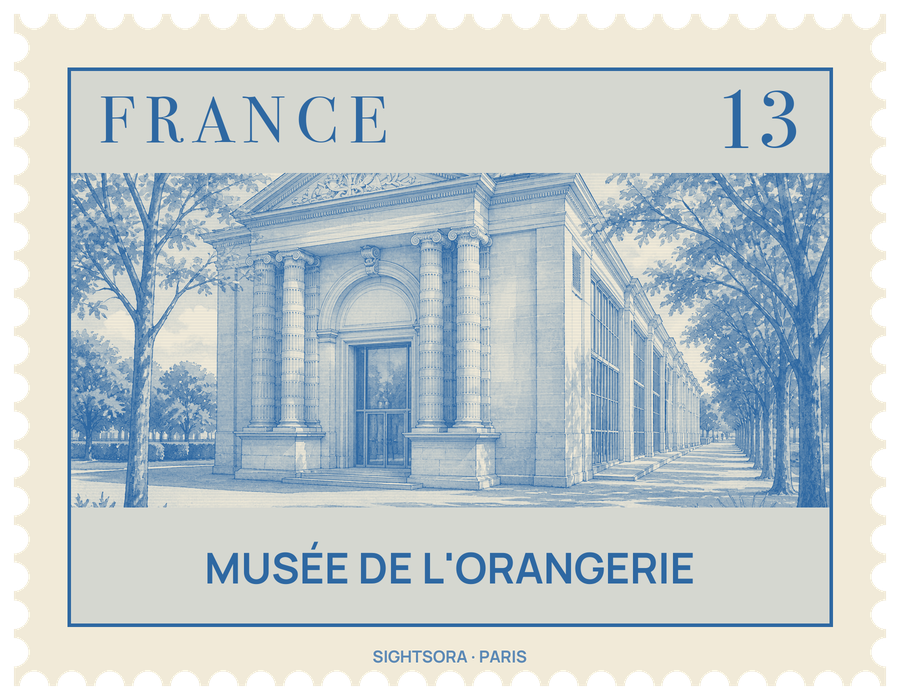
The building began life as a shelter for plants. Napoleon III had it built in 1852 so that the citrus trees of the Tuileries garden could spend the winter out of the cold; the architect Firmin Bourgeois gave it a glazed south wall facing the river and kept the north side almost blind against the wind. Louis Visconti designed the doorways at the east and west ends, where carved cornucopias, plants and ears of corn on the columns still hint at its original use. After 1871 the State took it over and used it for concerts, exhibitions and even dog shows.
The Water Lilies arrived after World War I. Monet was painting the Nymphéas series for the State, and Georges Clemenceau pushed for the panels to go to the Orangerie rather than elsewhere. The gift was settled in 1922, and Monet worked with the architect Camille Lefèvre on the rooms: the panels stand two metres high and run for 91 metres in all, and Monet insisted on skylights so that they would be seen in daylight. Because the building lies on an east–west axis, the rooms follow the course of the sun. The museum opened on 17 May 1927, a few months after the painter's death, under the name Musée Claude Monet.
The rest of the collection comes from the art dealer Paul Guillaume, who hoped to found a public museum of modern French art, and from Jean Walter; their widow, Domenica Walter, agreed to its display at the Orangerie, and the State acquired the two collections in 1959 and 1963. A renovation by Olivier Brochet between 2000 and 2006 removed the upper floors that had been added over the Water Lilies, bringing natural light back into the oval rooms, and placed the Walter-Guillaume collection in new galleries dug into the basement. During the work, remains of the Louis XIII wall that once protected the Tuileries Palace came to light.
Visitors usually begin with the two oval rooms of the Water Lilies on the main level before going down to the Walter-Guillaume galleries. The restored Water Lilies gallery also hosts occasional dance and piano concerts.
Getting there
The museum is on the Place de la Concorde side of the Tuileries Garden, near Concorde metro station, and within reach of both the Louvre and the Musée d'Orsay.