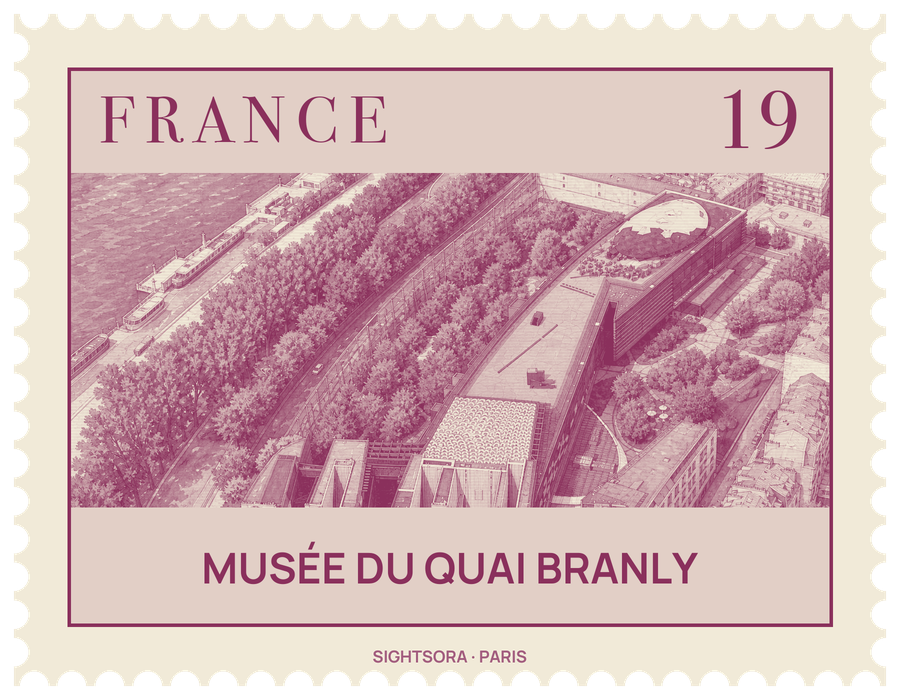
The Musée du quai Branly opened in June 2006 at 37 quai Jacques Chirac in the 7th arrondissement; it took its name from the riverside quay, named after the scientist Édouard Branly, and in 2016 added the name of Jacques Chirac, the president who drove the project.
The collections come from two older institutions, the ethnology laboratory of the Musée de l'Homme and the MAAO, a now-closed national museum of art from Africa and Oceania, plus later acquisitions. In all they run to more than a million items, among them some 300,000 works, 700,000 photographs, 10,000 musical instruments and 25,000 textiles and garments, of which around 3,500 are on show at any one time. Highlights range from a 19th-century Sango reliquary from Gabon and a Pende mask from Congo to a Nisgaʼa heraldic pole from British Columbia carved in 1890, a Māori sculpture from New Zealand and bark paintings by Aboriginal Australian artists. A small selection is also shown in the Louvre, in its Gallery of the Five Continents.
From a modest entrance, a winding ramp rises gently to the main gallery, some two hundred meters long and kept dim, with direct light only on the objects. There are no walls between the four regions, so a walk through the hall becomes a journey from one continent to the next, and labels are kept brief so the objects can be seen first as works of art. From outside, the smaller galleries on the north side show as boxes of different colours jutting from the façade, and the mezzanines above the main gallery hold temporary exhibitions.
Gilles Clément designed about 17,500 m² of small gardens with streams, hillocks, pools and groves, with no lawns, gates or straight axis, and paths that wander without an obvious destination; a double glass wall on the Seine side blocks most of the street noise. On the administrative Branly building, the botanist Patrick Blanc created a living wall of 15,000 plants of 150 varieties, and the ceilings and façade of the rue de l'Université building carry works by eight Indigenous Australian artists. Beneath the main hall, the Théâtre Claude Lévi-Strauss stages concerts, films and talks.
The museum has been at the centre of debate since it opened, both over whether to present its objects as art or as ethnography and over collections acquired during colonial rule. After a 2018 report by Bénédicte Savoy and Felwine Sarr on the restitution of African heritage, 26 objects taken from historical Dahomey were prepared for return to Benin by late 2021.