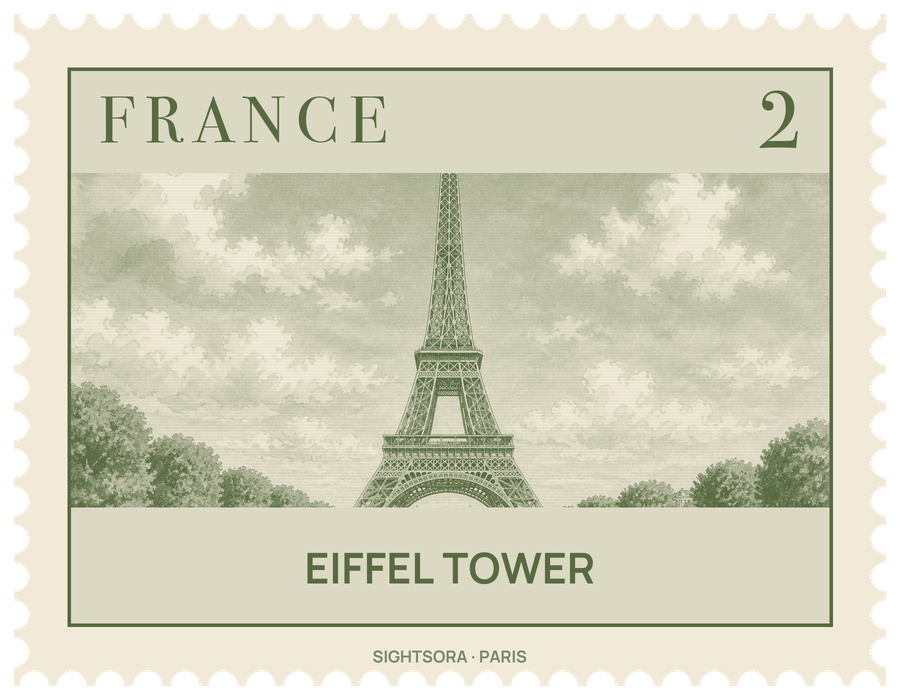
Gustave Eiffel's company built the tower between 1887 and 1889 as the centrepiece of the Exposition Universelle that marked the hundredth anniversary of the French Revolution, and Parisians nicknamed it "La dame de fer", the Iron Lady. The design came from two of Eiffel's senior engineers, Maurice Koechlin and Émile Nouguier, with arches and other ornament added by the architect Stephen Sauvestre. In 1991 it was included in the UNESCO World Heritage listing of the banks of the Seine in Paris.
Not everyone wanted it. In February 1887 a group of artists and writers, including Charles Garnier, Guy de Maupassant and Charles Gounod, published a protest against a "useless and monstrous" tower that would loom over Paris; Eiffel answered that the laws of natural forces follow the hidden laws of harmony. Work went ahead anyway: the factory at Levallois-Perret produced 18,038 parts that were assembled on site with 2.5 million rivets, and only one worker died. The tower was meant to be temporary and due to come down in 1909, but its usefulness for radio telegraphy saved it; in 1914 a transmitter here jammed German communications before the First Battle of the Marne.
Visitors have three levels to reach. The first two can be climbed on foot, more than 300 steps each, or reached by lift; the top level is normally served only by lift, and its upper platform stands 276 metres above the ground. The first level has a glass floor added in the 2014 refurbishment and the restaurant Le 58 Tour Eiffel; the second holds Le Jules Verne, a restaurant reached by its own lift in the south pillar. At the top, Gustave Eiffel's small private apartment, where he received guests such as Thomas Edison, has been opened with period furnishings and lifelike figures of Eiffel and his visitors, and there is a champagne bar.
The details reward a closer look. Around the tower, Eiffel had 72 names engraved, those of French scientists, mathematicians and engineers, partly in reply to the artists' protest; painted over in the early 20th century, they were restored in 1986–87. The paint is applied in three shades, lighter at the top and darker towards the ground, to sit well against the Paris sky, and the original hydraulic machinery of the lifts is displayed in a small museum at the foot of the east and west legs. A bust of Eiffel by Antoine Bourdelle stands at the base of the north leg.
Getting there
The tower stands where the quai Branly meets the Pont d'Iéna. For the RER, the closest stop is Champ de Mars – Tour Eiffel; on the Metro, it is Bir-Hakeim.