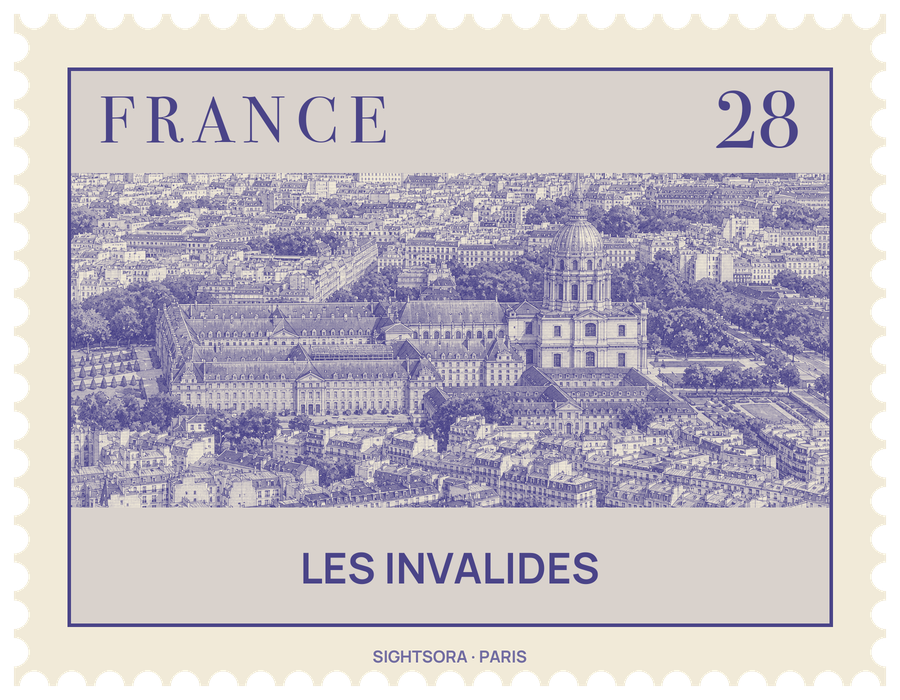
Its long north front faces a broad esplanade that runs down to the Seine and the Pont Alexandre III. Libéral Bruant was the first architect, and by 1676 the façade measured 196 metres with fifteen courtyards behind it, the largest of them the cour d'honneur, laid out for parades.
The Dôme des Invalides, designed by Jules Hardouin-Mansart and finished in 1706, was built as the king's private chapel. On a Greek-cross plan, it rises through a dome and lantern to 107 metres, its outer surface decorated with gold leaf. Inside, the dome is in fact two shells: the lower one is open at its centre, so that visitors look up through it to a painted heaven by Charles de La Fosse, completed in 1705, showing Saint Louis offering his sword to Christ, lit by windows hidden from view.
Napoleon's remains were brought back from Saint Helena in 1840 and kept in a side chapel of the Dôme for over twenty years while Louis Visconti's tomb was made; it was completed in 1861. The quartzite sarcophagus rests on green granite in an open crypt, ringed by a gallery on twelve pillars with reliefs of his achievements. Around it, the side chapels hold the tombs of Turenne, Vauban's heart, Napoleon's brothers Joseph and Jérôme, Marshal Foch and Marshal Lyautey, and Napoleon II has lain in the crypt since 1969.
Directly behind the Dôme, and separated from it by a glass wall, is the Cathédrale Saint-Louis-des-Invalides, where the veterans were once required to attend services every day. Enemy flags captured by the French army hang along its nave, and its organ was built between 1679 and 1687 by Alexandre Thierry in a carved case designed by Hardouin-Mansart. Beneath it, the Caveau des Gouverneurs holds 82 military figures, among them Rouget de Lisle, author of La Marseillaise.
The buildings around the courtyards house the Musée de l'Armée, formed in 1905 from the artillery and army history museums, whose collections run from antiquity to the 20th century, and the Musée des Plans-Reliefs, with scale models of fortified towns begun in 1668 for Louis XIV's war minister. On 14 July 1789 crowds seized the cannons and muskets stored in the cellars here before marching on the Bastille. The original purpose has not disappeared: the Institution Nationale des Invalides, which dates its work to 1674, still cares for wounded soldiers and now also for victims of terrorist attacks.