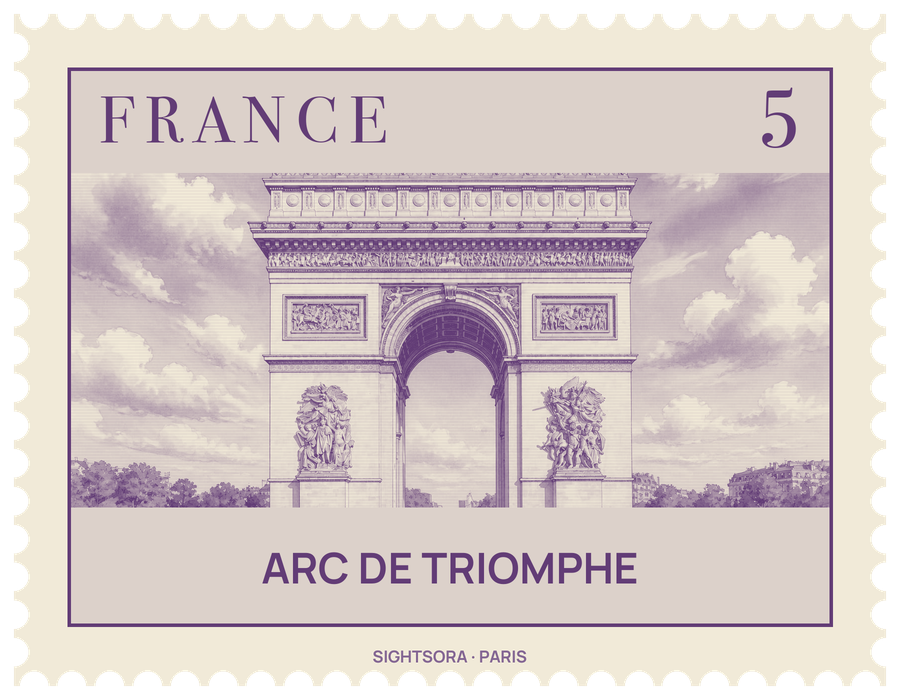
The square was long called the Place de l'Étoile and is now the Place Charles de Gaulle. Jean-François Chalgrin modelled his design on the Arch of Titus in Rome; the arch rises to about 49.5 metres. Beneath it lies the Tomb of the Unknown Soldier of World War I, where an eternal flame burns.
Building it took three decades. The foundations by themselves needed two years of work, and when Napoleon came into Paris with his new bride Marie-Louise in 1810, all he could show her was a wooden mock-up. Chalgrin died in 1811, work stopped during the Bourbon Restoration, and the arch was only finished in 1836 under Louis Philippe I. Several schemes to put a sculpture group on top came and went; a plaster quadriga sat up there from 1882 to 1886 until the weather wore it down, and after that the idea was dropped.
The sculpture is applied to the stone mass like separate trophies rather than running friezes. Four large groups stand at the foot of the pillars, and the best known, François Rude's Departure of the Volunteers of 1792, is usually called La Marseillaise. The others, by Jean-Pierre Cortot and Antoine Étex, mark the Triumph of 1810, the Peace of 1815 and the Resistance of 1814. Higher up, six reliefs show scenes such as the Battle of Austerlitz and the crossing of the Arcole bridge, while 30 shields on the attic carry the names of victories. Under the small arches, the inner walls list 660 military leaders of the Republic and the Empire, with those who fell in battle underlined.
The Unknown Soldier was laid to rest under the arch on 28 January 1921, after a public letter campaign overturned a plan to bury him in the Panthéon; the inscription on his slab names him as a French soldier who died for his country in the war of 1914–1918. A ceremony takes place here every 11 November, and since the burial military parades have gone around the arch instead of marching through it. In 1919 the pilot Charles Godefroy flew a Nieuport biplane through the main vault, and in 2021 the monument was wrapped in silvery blue fabric for L'Arc de Triomphe, Wrapped, a project of Christo and Jeanne-Claude.
The climb to the rooftop terrace is 284 steps: a 240-step spiral staircase inside one of the pillars leads to a mezzanine in the attic, then a museum hall with large models of the arch and interactive displays on its history, and finally about 40 more steps to the roof and its panorama over Paris. Lifts serve the museum and the terrace.
Getting there
The nearest Metro and RER stop is Charles de Gaulle – Étoile. Traffic on the roundabout is heavy, so pedestrians reach the arch through two underpasses entered from the Champs-Élysées and the Avenue de la Grande Armée.