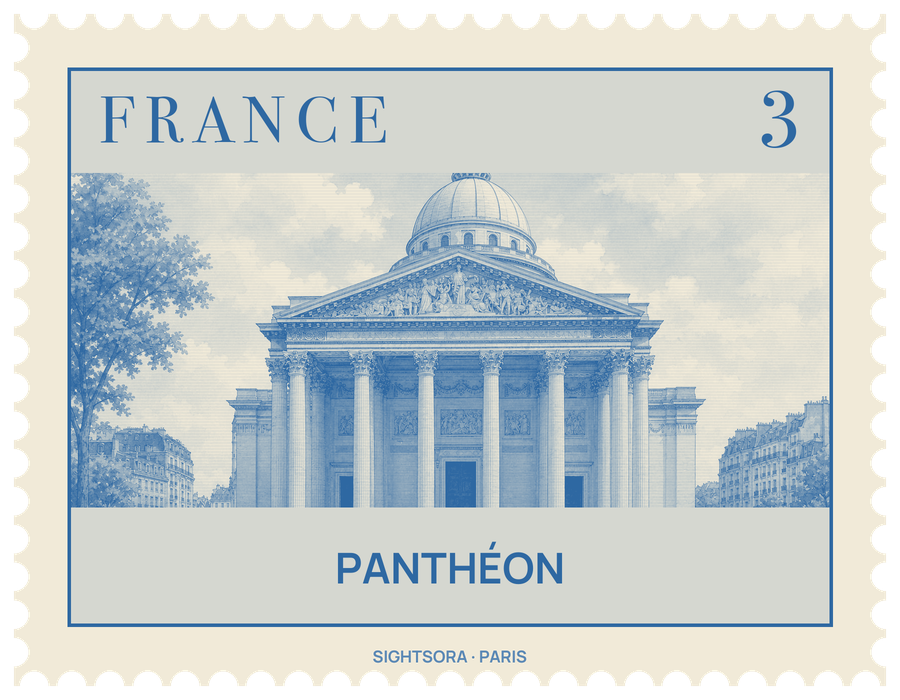
Jacques-Germain Soufflot designed it for King Louis XV as a church for Saint Genevieve, patron saint of Paris, but by the time it was finished in 1790 the Revolution had begun, and in 1791 the Assembly turned it into a resting place for the nation's great men. The words over the entrance, "Aux grands hommes la patrie reconnaissante", date from that decision.
The hill was already loaded with history: the forum of Roman Lutetia stood here, Genevieve was first buried here, and in 508 Clovis, King of the Franks, built a church on the spot. Louis XV vowed in 1744 to replace the run-down abbey church if he survived an illness; the foundations went in in 1758, and after Soufflot died in 1780 his student Jean-Baptiste Rondelet completed the work. Soufflot reinforced the stone with a system of iron rods, and those bars were replaced in a restoration carried out between 2010 and 2020.
Over the next century the building swung back and forth between church and secular temple, and each switch left traces: the pediment sculpture was replaced, the cross on the dome gave way to a flag and came back, and windows were walled up so the interior would feel dim and solemn. In 1881 the Third Republic settled the matter for good, and Victor Hugo's burial in 1885 was the first in the crypt for more than fifty years. Today's pediment, by David d'Angers, shows the Nation handing out crowns to great men, with Voltaire and Rousseau among the figures on the left and Napoleon on the right.
Inside, the dome turns out to be three domes nested inside one another. Through the open centre of the lowest one, visitors can see Antoine-Jean Gros's painting The Apotheosis of Saint Genevieve on the second. The walls of the naves carry 19th-century paintings of the lives of Saint Genevieve, Saint Denis, Clovis, Charlemagne, Louis IX and Joan of Arc, by Puvis de Chavannes, Alexandre Cabanel and others. Under the dome hangs a copy of the pendulum Léon Foucault hung here in 1851 to show that the Earth turns.
Burial in the crypt requires an act of parliament. Voltaire and Rousseau lie there, as do Victor Hugo, Émile Zola, Jean Jaurès, Jean Moulin, Louis Braille and Soufflot himself; Marie Curie, interred in 1995, was the first woman buried there on her own merit. Alexandre Dumas was carried in by Republican Guards in 2002, Simone Veil arrived in 2018, Josephine Baker was inducted in 2021, and in 2026 the historian Marc Bloch and his wife Simonne Vidal followed. A plaque unveiled in 2007 honours more than 2,600 people whom Yad Vashem named Righteous Among the Nations for saving Jews during the Occupation.