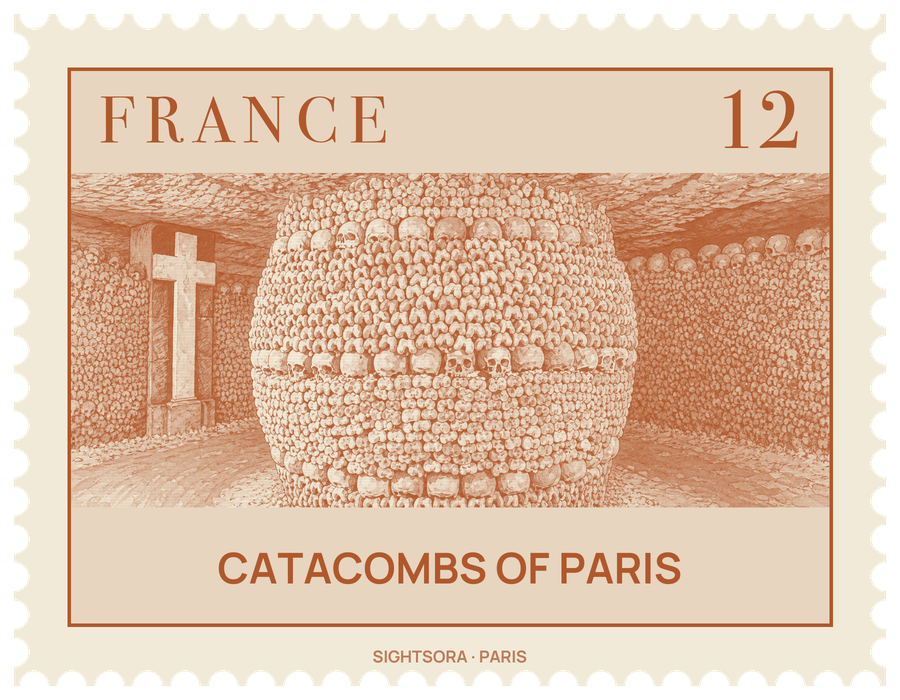
The remains of millions of Parisians were brought here as the city's cemeteries were closed, and the skulls and long bones are stacked into ordered patterns along the passages. Over the way into the ossuary, an inscription orders those who enter to halt, because beyond it begins the empire of Death.
The tunnels began as stone mines. Much of the Left Bank sits on Lutetian limestone that was dug out to build the city, often from uncharted shafts that were later forgotten. A run of cave-ins from 1774, starting with a house on the "rue d'Enfer", led Louis XVI to set up a commission and then the General Inspection of Mines to shore up the ground. At the same time the Saints Innocents cemetery near Les Halles was hopelessly overfull, and after a basement wall next to it gave way in 1780 under the weight of the mass grave, the decision was taken to move the dead underground.
From 1788 wagons draped in black cloth made the trip by night from the old cemeteries to a shaft near the Rue de la Tombe-Issoire. Saints-Innocents supplied by far the largest share, but bones also came from Saint-Étienne-des-Grès, the Madeleine, the Errancis cemetery and Notre-Dame-des-Blancs-Manteaux. Through these transfers the Catacombs also hold the remains of figures of the French Revolution, among them Danton, Robespierre, Lavoisier, Madame Roland and Camille Desmoulins.
At first the bones were simply heaped together. From 1810 Louis-Étienne Héricart de Thury, head of the mines inspection service, turned the galleries into a mausoleum that could be visited: he had the skulls, femurs and tibias arranged in the walls seen today, set up salvaged cemetery monuments among them, added archways and tablets carrying warnings and reflections on death, and walled the ossuary off from the rest of the tunnel network. During World War II, members of the Resistance used the tunnels, and Colonel Rol-Tanguy directed the insurrection for the liberation of Paris from a headquarters underground.
The ossuary forms only a small part of the tunnels under Paris, though Parisians often call the whole network "the catacombs". The entrance is at 1 avenue du Colonel Henri Rol-Tanguy, close to Place Denfert-Rochereau, where the old Barrière d'Enfer city gate stood.