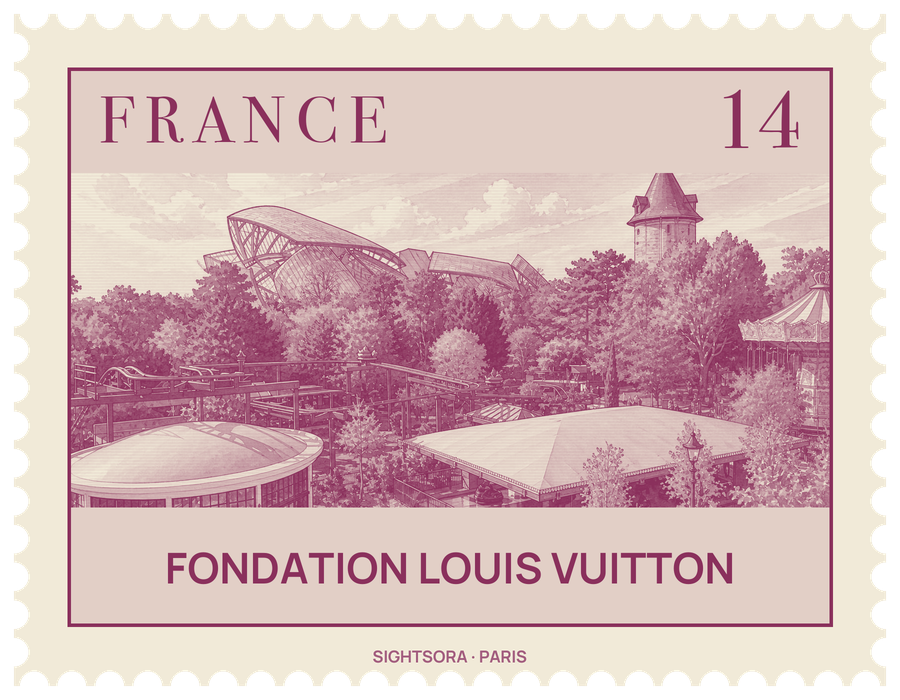
The art museum and cultural centre, backed by the LVMH group and run as a separate nonprofit, opened on 20 October 2014 in the 16th arrondissement of Paris, where the city borders Neuilly-sur-Seine.
The project started with a meeting in 2001 between Bernard Arnault, head of LVMH, and Gehry. Walking the garden, Gehry drew on the glass Grand Palais and on 19th-century glasshouses such as the Palmarium, which the Jardin d'Acclimatation put up in 1893. He also had to work within the footprint and two-storey height of a bowling alley that once stood on the site; anything taller had to be made of glass. A group defending the Bois de Boulogne fought the building in court, and work went ahead only after the city changed its planning rules and a special law declared the Foundation to be in the national interest.
Inside are 11 galleries of different sizes on two floors, the upper ones lit through skylights partly hidden from view, along with a 350-seat auditorium one level down and roof terraces on several levels used for events and art installations. The galleries are clad in Ductal, a white fibre-reinforced concrete, and each glass panel of the sails is curved individually to match Gehry's drawings. More than 400 people fed plans and engineering rules into a single shared 3D model, from which robots moulded the façade panels.
The collection draws on works owned by LVMH and Bernard Arnault, including pieces by Jeff Koons, Jean-Michel Basquiat and Gilbert & George. The Foundation also commissioned works for particular spots in the building: Ellsworth Kelly's curtain Spectrum VIII, made of 12 coloured strips, hangs in the auditorium, and Olafur Eliasson's Inside the Horizon lines a walkway with 43 yellow prism-shaped columns lit from within. The auditorium doubles as a small concert hall; Lang Lang gave its first recital on 24 October 2014.