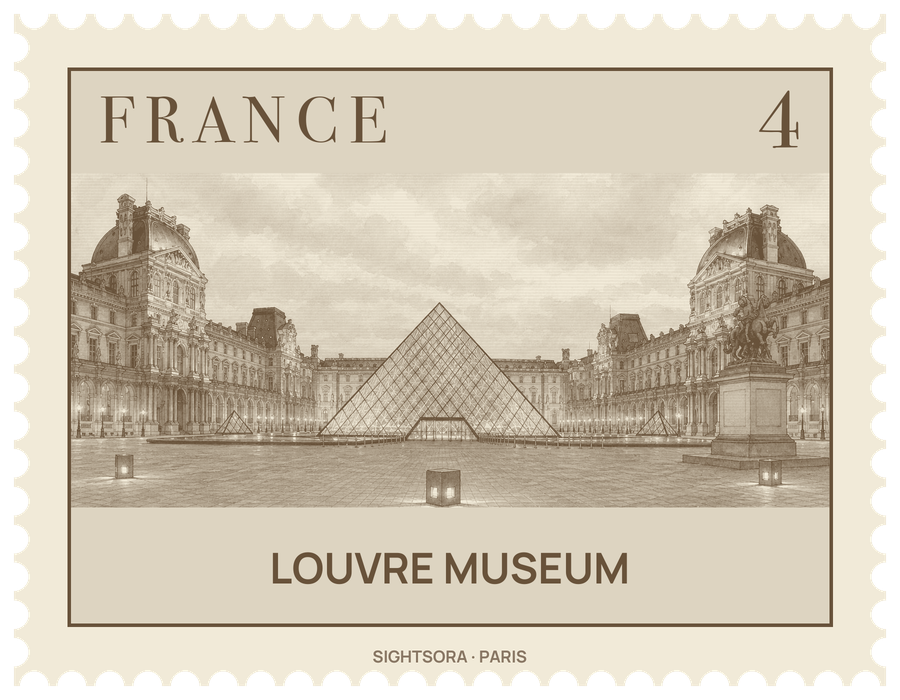
Philip II began the palace in the late 12th century as a fortress guarding Paris from the west, and the remains of that medieval Louvre can still be seen in the basement. Francis I made it the main royal residence in 1546 and began rebuilding it in the French Renaissance style; after Louis XIV moved his household to Versailles in 1682, the building turned into a home for the royal collection and the academies of art.
The museum itself is a product of the Revolution. It opened on 10 August 1793, a year to the day after the fall of the monarchy, with 537 paintings, most of them from the royal collections or seized from the Church and émigrés. Under Napoleon, whose campaigns brought in looted art from across Europe and Egypt, it was briefly called the Musée Napoléon; after Waterloo many of those works went back to their owners. Napoleon III's architects Louis Visconti and Hector Lefuel later enlarged the palace around what is now the Cour Napoléon, and in 1871 the museum narrowly escaped the fire that destroyed the neighbouring Tuileries Palace.
Since 1993 the main way in has been the hall beneath I. M. Pei's glass pyramid in the Cour Napoléon, part of President François Mitterrand's Grand Louvre project, which also moved the Finance Ministry out of the Richelieu Wing and gave almost the whole palace to the museum. A second entrance at the Porte des Lions, at the western end of the Denon Wing, is not always open.
Eight curatorial departments cover the collections, from Egyptian, Near Eastern and Greek, Etruscan and Roman antiquities to Islamic art, sculpture, decorative arts, paintings, and prints and drawings. The Great Sphinx of Tanis guards the Egyptian rooms, which hold the Seated Scribe, and the Near Eastern galleries show the Code of Hammurabi and Assyrian winged bulls. Among the paintings, Leonardo's Mona Lisa and Virgin and Child with St. Anne share the Denon Wing with Italian and Spanish works, while French and Northern European painting, from David's Coronation of Napoleon and Géricault's The Raft of the Medusa to Delacroix's Liberty Leading the People and Vermeer's The Lacemaker, hangs in the Richelieu Wing and the Cour Carrée.
The Galerie d'Apollon, which Charles Le Brun decorated for Louis XIV on a solar theme, holds part of the decorative arts collection, including the coronation crown of Louis XV and Charles V's sceptre; the rest fills the first floor of the Richelieu Wing, along with Napoleon III's apartments. The Islamic Art department, opened in 2012 in the covered Cour Visconti of the Denon Wing, gathers ceramics, metalwork, carpets and ivories, among them the Baptistery of Saint-Louis, a Mamluk brass basin.
Getting there
Two Métro stations serve the museum: Palais Royal – Musée du Louvre and Louvre – Rivoli. From Palais Royal, an underground passage leads straight into the Carrousel du Louvre and on to the hall under the pyramid.