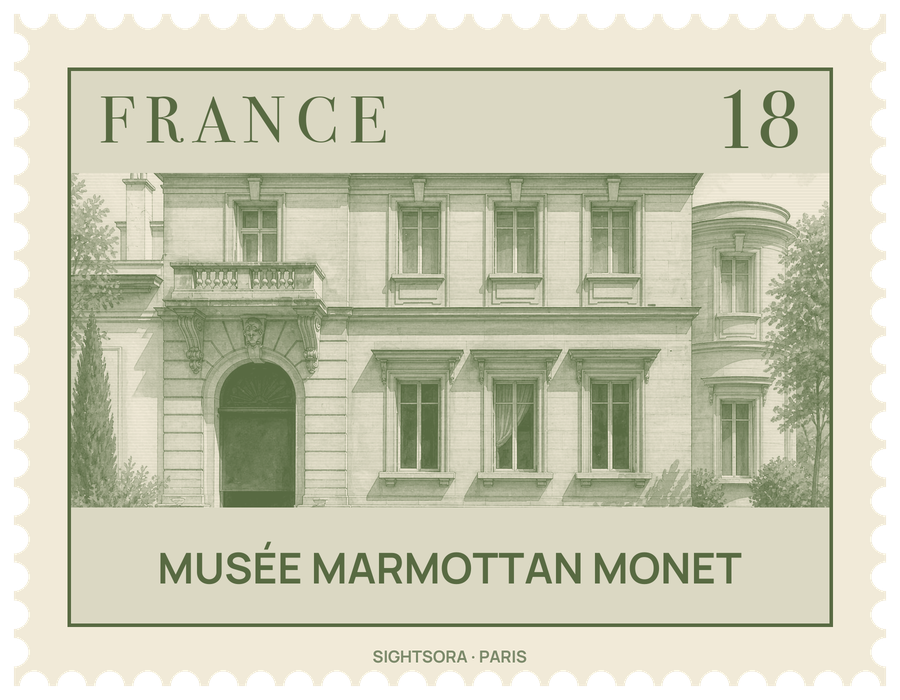
The Musée Marmottan Monet, in the 16th arrondissement of Paris, holds a large body of Monet's work, from views of Argenteuil to the Rouen cathedral, a group of Water Lilies and scenes of his garden at Giverny, along with an important collection of paintings by Berthe Morisot.
The house was built as a lodge for the Duke of Valmy and bought in 1882 by Jules Marmottan. His son Paul, a historian drawn to the Napoleonic period, added to the family collection of paintings, furniture and bronzes and turned the lodge into a town house with Empire decoration. He left the building and collection to the Académie des Beaux-Arts, which opened the Musée Marmottan in 1934. The Empire rooms survive, together with earlier paintings, sculpture and illuminated manuscripts, among them the Wildenstein Collection.
Two gifts reshaped the museum. In 1957 Victorine Donop de Monchy donated the Impressionist pictures collected by her father, Georges de Bellio, a doctor who treated several of the painters, Monet among them, and backed the movement early on. In 1966 Michel Monet, the painter's second son and only heir, left his collection of his father's work. A later donation from Nelly Duhem, whose adoptive father was the painter Henri Duhem, added more Impressionist and Post-Impressionist pictures.
The Monet works are shown in a large open room on a lower level created by the museum's curator, who took the hall built for the Water Lilies at the Musée de l'Orangerie as his model; it lets visitors follow the development of Monet's painting and look at the canvases from close up and from a distance. Impression, Sunrise itself was taken in an armed daylight robbery on 27 October 1985 along with eight other paintings; they were found in a villa in Corsica in December 1990, and the picture went back on display in 1991.
Beyond Monet, the museum shows works by Manet, Degas, Renoir, Pissarro, Sisley, Caillebotte, Gauguin, Boudin and Delacroix, sculpture by Rodin and, for the modern era, Chagall. The Morisot holdings, left by her descendants, take in more than twenty-five paintings with rare watercolours and pastels: country scenes, landscapes and portraits of young girls in soft colours. Since 1975 the museum has also put on two exhibitions a year on a single artist or collection.
Getting there
The museum stands in the 16th arrondissement at 2 rue Louis-Boilly; La Muette, on Métro line 9, is the closest station.