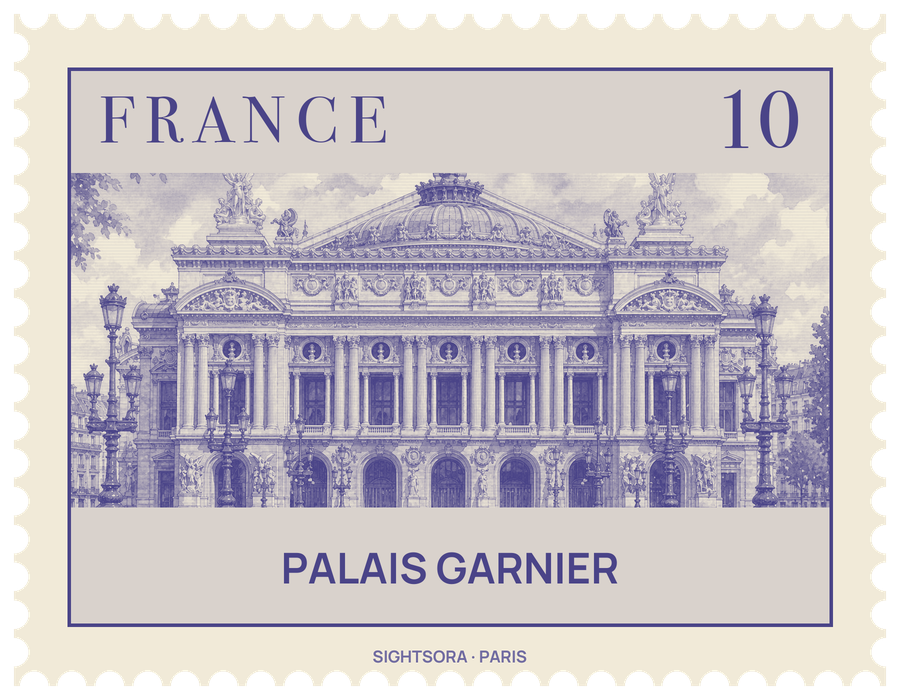
Napoleon III had it built for the Paris Opera between 1861 and 1875, and the relatively unknown architect Charles Garnier, who won the design competition, gave his name both to the building and to its exuberant mix of Baroque and Renaissance motifs and the classicism of Palladio, which he called simply the Napoleon III style. Since the Opéra Bastille opened in 1989, the company stages mostly ballet here; the house seats 1,979.
Garnier's entry was one of about 170 in the first round of the 1860–61 competition, and it was chosen on 29 May 1861. Building the foundations turned into a fight with groundwater that steam pumps running day and night could not clear, so Garnier designed a double foundation around a huge concrete cistern under the stage. That tank gave rise to the legend of a lake beneath the opera, which Gaston Leroux used in his 1910 novel The Phantom of the Opera. Work stopped during the siege of Paris in 1870–71, and the theatre was finally inaugurated with a gala on 5 January 1875.
The façade was decorated by fourteen painters and mosaicists and seventy-three sculptors. Charles Gumery's gilded groups Harmony and Poetry crown its two ends, and at street level four sculpture groups include Jean-Baptiste Carpeaux's The Dance, attacked as indecent when it appeared. Busts of composers from Rossini and Beethoven to Mozart and Meyerbeer stand between the columns, and Aimé Millet's group Apollo, Poetry and Music tops the gable of the stage tower.
Inside, a grand staircase of white marble with a red and green marble balustrade splits into two flights rising to the Grand Foyer, 54 metres long and 18 metres high, its ceiling painted by Paul Baudry with episodes from the history of music. In the Avant-Foyer, mosaics show couples from Greek myth, among them Orpheus and Eurydice. Over the horseshoe-shaped auditorium hangs a seven-ton bronze and crystal chandelier designed by Garnier; on 20 May 1896 one of its counterweights crashed through the ceiling and killed a concierge, an accident that found its way into Leroux's novel. Above it, since 1964, a ceiling by Marc Chagall shows scenes from operas by fourteen composers, from Mozart and Wagner to Debussy and Stravinsky.
Self-guided visits of the building include the Bibliothèque-Musée de l'Opéra, run by the Bibliothèque Nationale de France and housed in the Pavillon de l'Empereur, the west wing built so that Napoleon III could drive straight in; the Empire fell before it was finished, and parts of its dressed stone were left unfinished. On the east side, L'Opéra Restaurant, designed by Odile Decq, opened in 2011 and is open to the public.