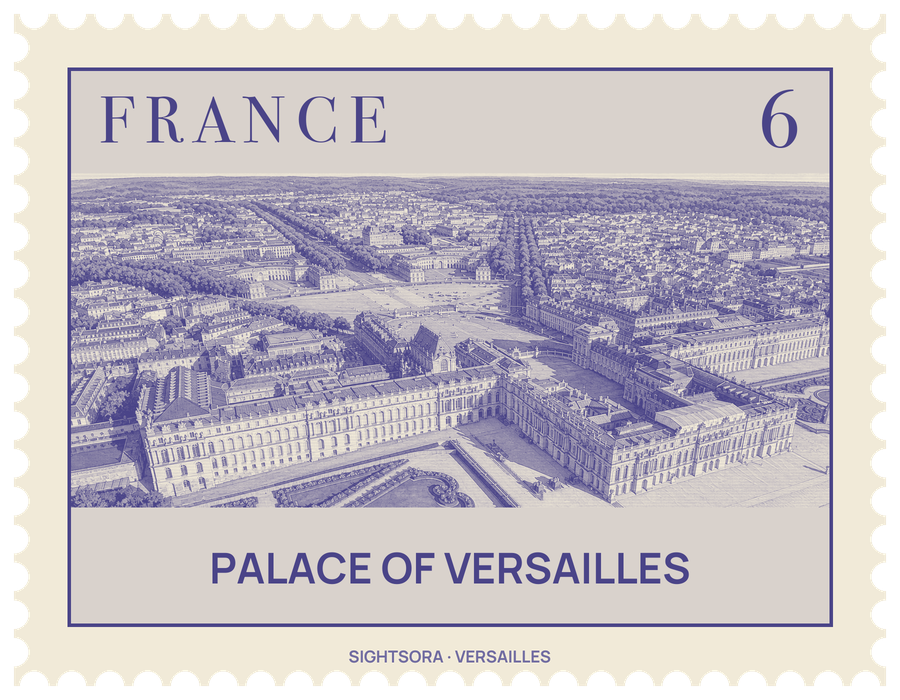
Louis XIV conceived it to glorify the French monarchy, and between 6 May 1682 and 6 October 1789 Versailles was the permanent home of the king, his court and the royal government, apart from the Regency years of 1715 to 1723. Louis XIV, Louis XV and Louis XVI all made it their main residence.
It began as a modest brick-and-stone hunting lodge that Louis XIII built in 1623 on marshy ground. After seeing Nicolas Fouquet's Vaux-le-Vicomte in 1661, Louis XIV hired the same team, the architect Louis Le Vau, the gardener André Le Nôtre and the painter Charles Le Brun, and from 1668 Le Vau wrapped his father's château on three sides in a new Italianate shell; the old brick courtyard front still survives at its heart. Jules Hardouin-Mansart added the Hall of Mirrors and the long north and south wings, and the chapel was the last building of the reign, finished in 1710. When a crowd marched from Paris in October 1789, the royal family was forced to leave, and the furnishings were later sold off in seventeen thousand lots.
The Hall of Mirrors, begun in 1678, sets 578 mirrors opposite 17 windows overlooking the gardens, under a ceiling by Le Brun showing scenes from Louis XIV's reign, many of them victories over the Dutch. The German Empire was proclaimed here on 18 January 1871, and the Treaty of Versailles ending the First World War was signed here in June 1919. The King's State Apartment leads through rooms named after planets and gods: the Salon of Hercules with its paintings by Veronese, the Salon of Apollo that served as throne room, and the Salon of Diana with Bernini's bust of Louis XIV. In the king's bedchamber Louis XIV died on 1 September 1715.
The Royal Chapel, 40 metres high, blends the Gothic tradition of French royal churches with the Baroque of Versailles; its single vault carries three frescoes, by Jean Jouvenet, Antoine Coypel and Charles de La Fosse. At the north end of the palace, the Royal Opera was built almost entirely of wood painted to look like marble and opened on 16 May 1770 for the wedding of the future Louis XVI and Marie Antoinette. After 1830 Louis Philippe I turned much of the building into a museum of French history, inaugurated in 1837; its Gallery of Battles still fills most of the south wing's upper floor, and the Coronation Room shows Jacques-Louis David's painting of Napoleon's coronation.
Le Nôtre laid out the gardens along an east–west axis, with paths, parterres, hedges and pools in the formal French style, and the park still covers about 800 hectares. Beyond them lie the Grand Trianon, a single-storey marble retreat that Hardouin-Mansart built for Louis XIV, and the Neoclassical Petit Trianon by Gabriel, which Louis XVI gave to Marie Antoinette. Nearby are her theatre and the Queen's Hamlet, a rustic village by Richard Mique with a farmhouse, dairy, dovecote, mill and a tower shaped like a lighthouse.