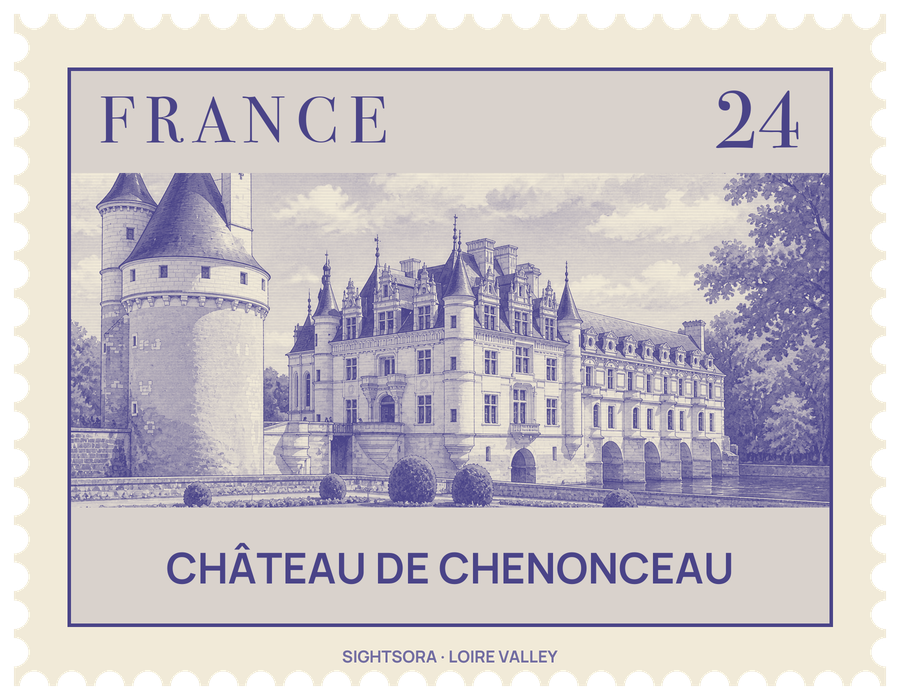
The house mixes late Gothic and early Renaissance forms and rises from the foundations of a former mill; it has been listed as a Monument historique since 1840. The château itself presents its story as one shaped by women who loved, ran and protected it, Diane de Poitiers and Catherine de Médicis among them.
Thomas Bohier, chamberlain to Charles VIII, bought the estate from the indebted Marques family in 1513, cleared away most of the old castle and raised a new residence, keeping only its 15th-century keep; his wife Katherine Briçonnet supervised the work and twice received Francis I. The crown seized the property in 1535 over unpaid debts, and Henry II later handed it to his mistress, Diane de Poitiers. She had Philibert de l'Orme build the arched bridge to the opposite bank and planted flower and vegetable beds and fruit trees, protected from floods by stone terraces.
When Henry II died in 1559, his widow Catherine de' Medici made Diane give up Chenonceau in exchange for the Château Chaumont and turned it into her own favourite home. She laid out further gardens, held lavish night-time festivities and had the grand gallery built along the bridge to span the whole river, designed by Jean Bullant and dedicated in 1577. After her, Louise of Lorraine, widow of Henry III, spent her last years here in mourning, among black hangings embroidered with skulls.
In the 18th century Louise Dupin hosted a literary salon at Chenonceau visited by Voltaire, Montesquieu, Buffon and Marivaux, with Jean-Jacques Rousseau as her secretary and her son's tutor; during the Revolution she kept the château from destruction by arguing that it was the only bridge over the river for many leagues. In 1913 it passed to Henri Menier, of the chocolate-making family. In the First World War the gallery became a hospital ward, and in the Second the château offered a way across the Cher from the occupied zone to the "free" zone on the other bank.
A visit leads through the rooms, bedrooms and salons, where the château's museum collections are displayed and fresh flower arrangements from its own floral workshop decorate the interiors. Outside, the grounds include formal Renaissance gardens, a flower and vegetable garden, the floral workshop and a maze, and the L'Orangerie restaurant serves meals on the estate. Guided tours of about an hour are offered by the tourist office during school holidays.