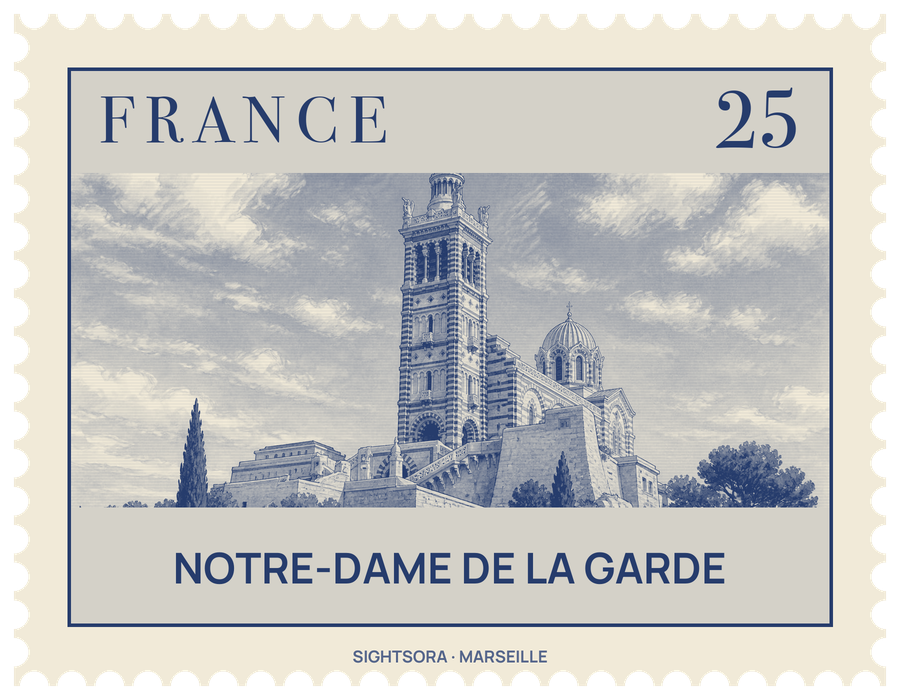
The people of Marseille call it la Bonne Mère, "the Good Mother", and treat it as the guardian of their city; it is also the goal of a pilgrimage on Assumption Day. Many visitors climb up as much for the panorama as for the church.
The hill was a lookout and seamark long before the present church. A priest named Pierre built a chapel to the Virgin here in the early 13th century, on land of the abbey of Saint-Victor, and sailors who survived shipwrecks came to leave thanks offerings. Francis I then put up a fort on the summit, completed in 1536 in time to help resist the siege by Charles V, so that soldiers and worshippers shared the hilltop; the small triangular fort can still be made out on a spur west of the basilica, with the king's worn coat of arms above its door.
The present basilica was begun in 1853 to plans by Henri-Jacques Espérandieu, a former pupil of Léon Vaudoyer, and took more than forty years to finish; it was consecrated in 1864 while still incomplete. Outside, bands of white Calissane limestone alternate with green stone from Golfolina near Florence. A double staircase 35 m long rises to a drawbridge that leads into the crypt and, by further steps, to the main door. Above the entrance, the square bell tower reaches 41 metres and is topped by a round belfry of sixteen red granite columns supporting the statue, made by electroplating copper and gilded with gold leaf.
The crypt, cut into the rock, is a dim Romanesque nave under low barrel vaults with six side chapels. On its main altar stands the Vierge au Bouquet, an older statue whose sceptre was swapped for flowers when it had worn badly. The upper church is the opposite: Neo-Byzantine, bright, with red and white marble columns and about 1,200 square metres of mosaics made by the Mora company of Nîmes with tesserae from Venice. Three cupolas show doves circling among white, blue and red flowers, the dome over the crossing has four angels on a gold ground, and the apse mosaic shows a ship whose sail bears the monogram of Mary. A silver statue of the Virgin by the Marseille goldsmith Chanuel stands behind the altar.
The walls are lined with painted ex-votos, most of them painted in the later 19th century, showing storms and shipwrecks but also fires, car and railway accidents and sickbeds, while model boats and planes hang from the ceiling of the upper church. In August 1944 French and Algerian troops took the hill from German forces; shrapnel marks remain on the stonework, and a tank that was hit during the attack can still be seen in the place du Colonel Edon. A museum on the site, opened in 2013, traces the eight centuries of the sanctuary's history.