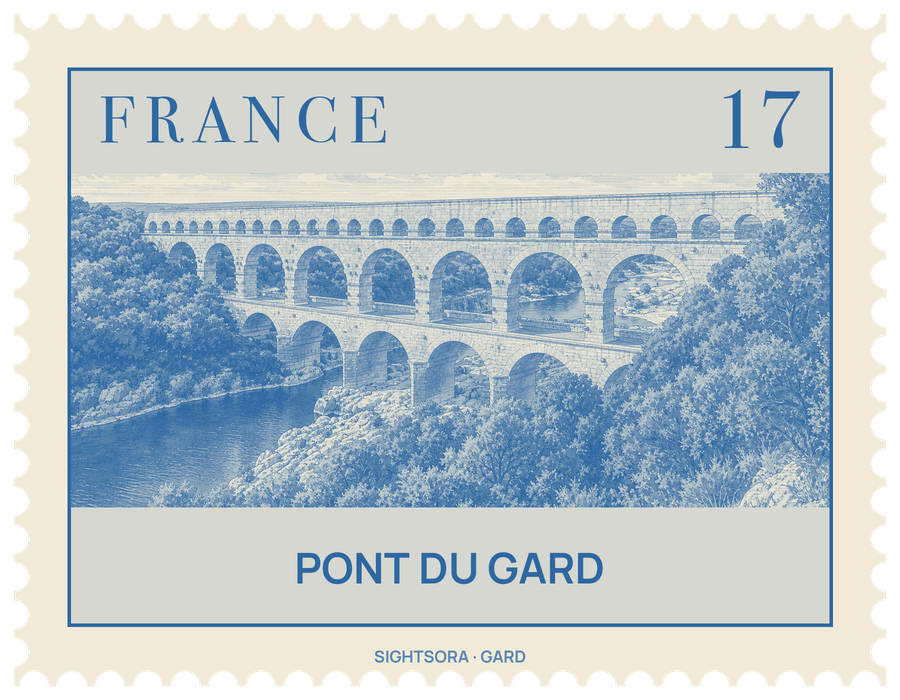
This was the bridge section of a Roman aqueduct built in the first century AD to bring water to the colony of Nemausus, today's Nîmes, along a winding course of about 50 km. It stands 49 m above the river at low water and runs 274 m in length, and it was added to the UNESCO World Heritage list in 1985.
The water came from the Fontaine d'Eure, a spring outside Uzès lying only 17 m higher than the basin where the water was shared out in Nîmes. To get the water there, the Roman engineers led the channel in a rough V round the eastern tip of the Garrigues de Nîmes, scrub-covered hills cut by deep valleys, instead of tunnelling through them. They varied the slope along the way so that this bridge would not have to be built even taller; across the bridge itself the channel drops by only 2.5 cm. At the end of the line, the water fed fountains, baths and private houses in the city.
The bridge was put together largely without mortar or clamps: blocks of "Pierre de Vers", the local reddish limestone full of shell fragments, were cut to fit so closely that friction and gravity hold them in place, and some weigh up to 6 tons. The stone came from the Estel quarry, about 700 metres downstream. Visitors can still see blocks left jutting out of the piers, where the scaffolding was supported during building, and inscribed markings such as fronte dextra and fronte sinistra that told the masons where each stone belonged. The channel at the top is about 1.8 m high, and its interior was finished smooth so that nothing slowed the water.
Neglect from the 4th century onwards let mineral crusts and roots clog the conduit, and the aqueduct had largely fallen out of use by around the sixth century. The bridge survived because it earned its keep as a toll crossing, first for the lords of Uzès and later for its bishops. In the 1620s the Duke of Rohan cut back part of the second tier to get his artillery across, badly weakening it. A road bridge by Henri Pitot was built against the lowest arches in 1743–47, and after Napoleon III visited in 1850 a restoration from 1855 to 1858 replaced worn stone and made it possible to walk along the conduit.
For centuries travellers have stopped here. French journeyman masons on their tour of the country carved their names into the stones, and Jean-Jacques Rousseau, who came in 1738, and Henry James, in 1884, both wrote about it. From 1996 the area around the bridge was cleared of traffic and shops and turned over to pedestrians, and a visitor centre and museum designed by Jean-Paul Viguier were built on the north bank to explain the aqueduct's history.