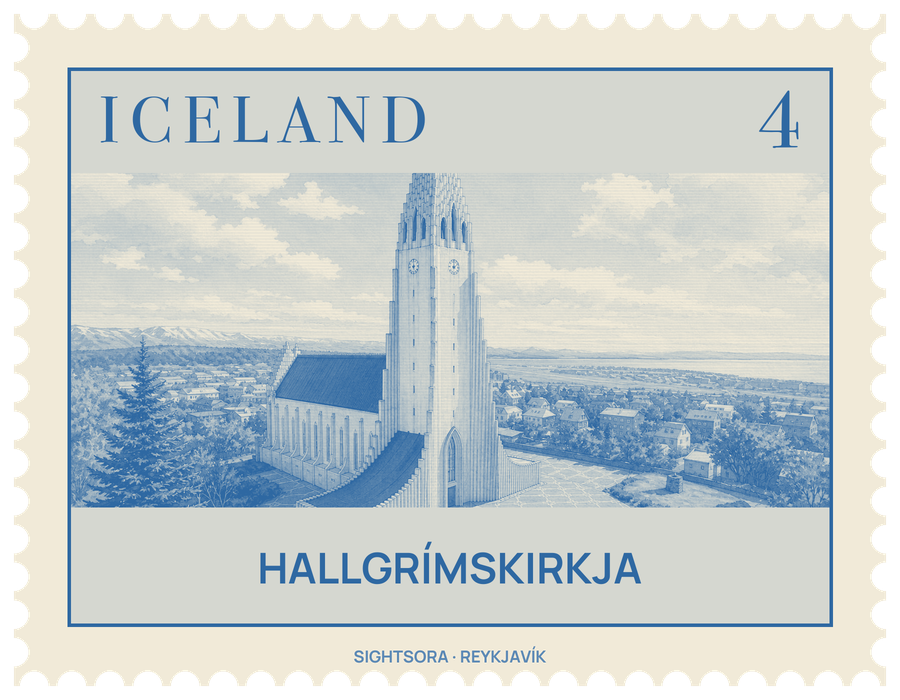
It is named after Hallgrímur Pétursson (1614–1674), the poet and clergyman who wrote the Passion Hymns, and since it was completed in 1986 it has come to be regarded as a symbol of Icelandic national identity.
State Architect Guðjón Samúelsson was commissioned in 1937 and is said to have drawn on Iceland's landscape of trap rock, mountains and glaciers, above all the basalt columns that form "organ pipes" at places such as Svartifoss. Its expressionist style has been compared with Grundtvig's Church in Copenhagen and the Kirche am Hohenzollernplatz in Berlin. Building took 41 years: work began in 1945, the crypt under the choir was consecrated in 1948, the wings and steeple stood complete by 1974, and the consecration of the nave in 1986 completed the work. The spire grew taller than first planned because church leaders wanted it to outshine Landakotskirkja, the Catholic cathedral.
The church has three parts: the tower, flanked by curved wings that hold service rooms; a nave of more traditional design; and, at the far end, a cylindrical sanctuary that has been likened to a Viking war helmet. The interior covers 1,676 square metres. Beside the entrance to the nave stands a statue by Einar Jónsson, given to the church in 1948, showing Jesus receiving the Holy Spirit after his baptism in the Jordan. The great organ by Johannes Klais of Bonn, finished in December 1992, is 15 metres tall, weighs 25 tonnes and has 5275 pipes and 72 stops, played electrically from a console of four manuals and pedals set apart from the pipes.
A lift carries visitors up the tower to a viewing deck that looks out over Reykjavík and the mountains around it. The tower also holds a carillon of 29 bells played from a keyboard; the three largest are named after Hallgrímur, his wife Guðríður and their daughter Steinunn. In front of the church stands a statue of the explorer Leif Erikson by Alexander Stirling Calder, which is older than the church: the United States presented it for the 1930 Althing Millennial Festival, marking a thousand years since Iceland's parliament first met at Þingvellir in 930.