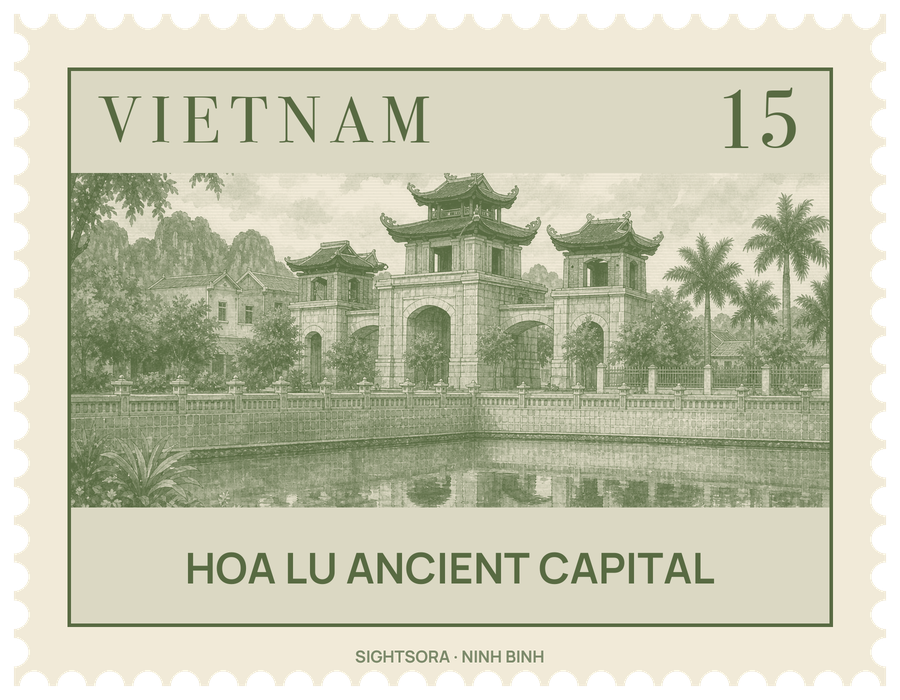
Đinh Bộ Lĩnh founded the independent state of Đại Cồ Việt here after defeating twelve rival warlords, and Hoa Lư became home to the first two imperial dynasties, the Đinh and the Early Lê. When Lý Công Uẩn, founder of the Lý dynasty, moved the court to Thăng Long, today's Hanoi, in 1010, Hoa Lư was left with the title of ancient capital.
The 10th-century rulers used the landscape as their defence, closing the gaps between the hills with ten stretches of earthen wall, each about 10 metres high and 15 metres thick, anchored with wooden stakes; some have been excavated. The capital covered 300 hectares in two enclosures divided by a hill, the Inner Citadel to the west and the Outer Citadel to the east, both reaching the Hoàng Long River. Few traces of the 10th-century city remain, but the Outer Citadel holds most of what visitors come to see, among several dozen monuments in the area.
The Temple of Đinh Tiên Hoàng, raised by local people on the site of the main royal palace, follows the feng shui ideal of a river in front and a mountain behind. Some 300 metres to the north, the Temple of Lê Đại Hành stands against Den Mountain; in its main hall the seated statue of the emperor in his throne is flanked by Empress Dương Vân Nga, widow of Đinh Tiên Hoàng and later wife of Lê Đại Hành. Đinh Tiên Hoàng's tomb lies on Mã Yên mountain nearby, and Lê Đại Hành's at its foot.
Nearby, the Nhất Trụ pagoda, built on Lê Đại Hành's orders, keeps artefacts from the 10th and 11th centuries and an original stone pillar in its courtyard. A small temple close to it honours Princess Phất Kim, Đinh Tiên Hoàng's daughter, who became a nun at the pagoda and drowned herself in a well there after her father was killed in 979. In Thiên Tôn Cave, where legend says Đinh Bộ Lĩnh received a prophecy of victory, the outer chamber is dedicated to the Buddha and the inner one to Daoist immortals, and the altars, pillars and dragon carvings are all cut from the living rock.
Each year Hoa Lư holds a festival for the two kings, with a procession from the Hoàng Long River to their temples, ceremonies, games, a fair and boat races on the river, while the villagers of Truong Yen stage a play about Đinh Tiên Hoàng's boyhood.