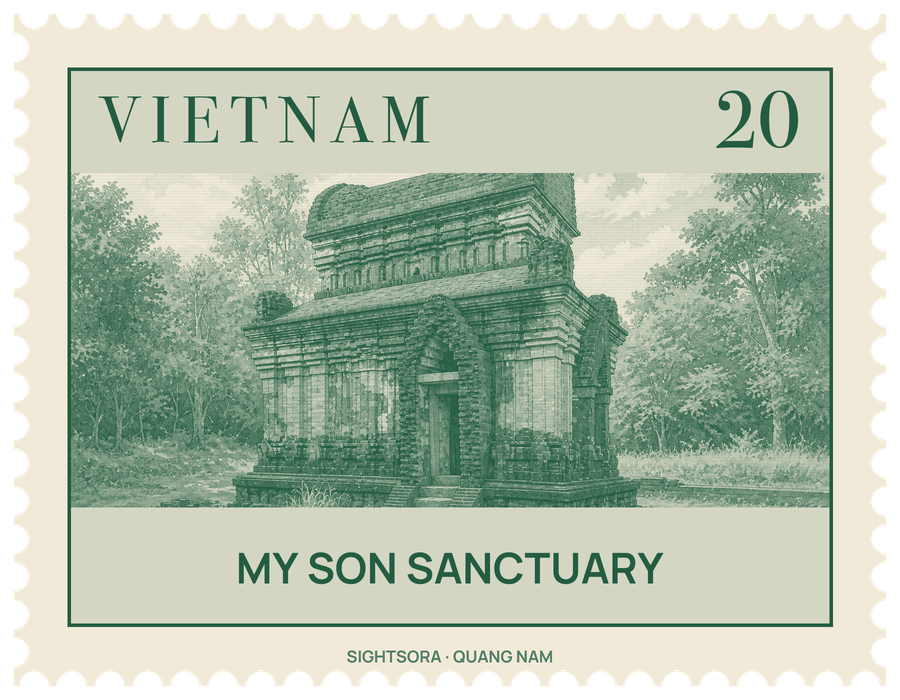
Rulers of Champa, the Indianized kingdom of the Cham, built and rebuilt shrines here from the 4th to the 13th century to worship Shiva, honoured above all as Bhadreshvara, and they buried royalty and national heroes in the valley as well. The site lies in Thu Bồn commune, 36 km south of Hội An and around 10 km from Trà Kiệu, the old Champa capital, and it was listed as a UNESCO World Heritage Site in 1999 as evidence of a vanished Asian civilization.
The story begins with King Bhadravarman I, who reigned from 380 until 413 and gave the whole valley to Bhadreśvara, a name built from his own name and the word for "lord". His stele asks later kings, out of compassion, not to destroy what he had given. His wooden temples burned in 535 or 536, and in the 7th century King Sambhuvarman rebuilt them; a stele of 657 set up by King Prakasadharma, who honoured Vishnu as well as Shiva, helps scholars rebuild the line of Cham kings. Most of the temples standing today date from the late 10th and 11th centuries, the work of Harivarman II and Harivarman IV. The last major Cham inscription here, from King Jaya Indravarman V, is dated 1243, and by the early 15th century the area had passed to the Viet.
Forgotten after the decline of Champa, the ruins came back to light in 1898, found by Camille Michel Paris, a Frenchman, and in 1899 Henri Parmentier counted the remains of 71 temples. He gave a letter to each of the ten principal groups and a number to each building within a group, so that "E1" means building 1 of group E. French restorers worked on the temples from 1937 to 1943, but in August 1969 United States aircraft bombed the area, then a base area of Vietnamese communist forces, and much of the complex was destroyed. Temple A1, long praised as the masterpiece of Cham architecture, was reduced to a pile of bricks.
What remains still shows how the Cham built. A temple group usually has a kalan, a brick tower sanctuary housing the deity; a mandapa, the entrance hall in front of it; a kosagrha, a fire-house with a saddle-shaped roof where the god's valuables were kept or food was cooked; and a gopura, a gate-tower into the walled precinct. Nearly everything is of red brick, with the carving cut straight into the bricks, and only B1 is built of stone. Six of the seven recognised styles of Cham art can be traced here. Polish conservators from Lublin led by Kazimierz Kwiatkowski carried out restoration work in 1981, and between 2017 and 2022 the Archaeological Survey of India restored the A, H and K groups.
Many statues were taken to France or to museums in Vietnam, among them Da Nang's Museum of Cham Sculpture, which keeps a pedestal and a tympanum from temple E1. Others are on view in a museum at the site itself, set up with funding from benefactors in Germany and Poland. Around 32 steles have been found at Mỹ Sơn, inscribed in Sanskrit and old Cham between the 5th and the 12th century, most of them recording gifts of land, people or treasure to the gods.