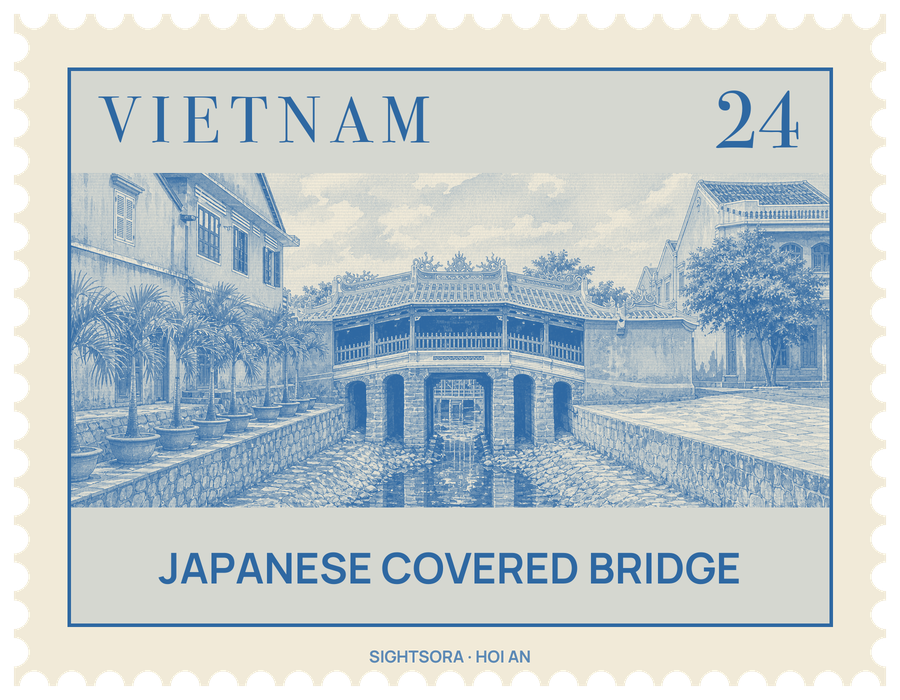
Each brick bridgehead has two spans, and the five spans of the middle section rest on brick pillars standing in the water. Three separate but joined roofs cover the three parts of the bridge, and the temple sits at the north end, entered from the middle of the bridge with the water below.
Japanese merchants who had settled in the port, then called Faifo, started the bridge in 1593 and finished it in 1595, linking their quarter with the Chinese enclave across the canal. In 1653 they added the temple; legend says it was meant to calm Namazu, a monster believed to cause earthquakes. That is why statues of a monkey and a dog guard the temple: in Japanese folklore these two gods keep Namazu under control. The temple has long been an altar to Trấn Vũ, honoured with a yearly festival.
When lord Nguyễn Phúc Chu visited in 1719, he gave the bridge the name Lai Viễn Kiều, "a bridge to welcome guests from afar", and the name is still written in Chinese characters in front of the temple entrance; more chữ Hán inscriptions appear across the bridge and temple. Look up at the roof, where porcelain bowls cap the ends of the tiles. Repairs in 1817, 1865, 1915 and 1986 slowly replaced Japanese features with Vietnamese and Chinese ones, so the bridge seen today blends all three. It was made a National Historic-Cultural Relic in February 1990.