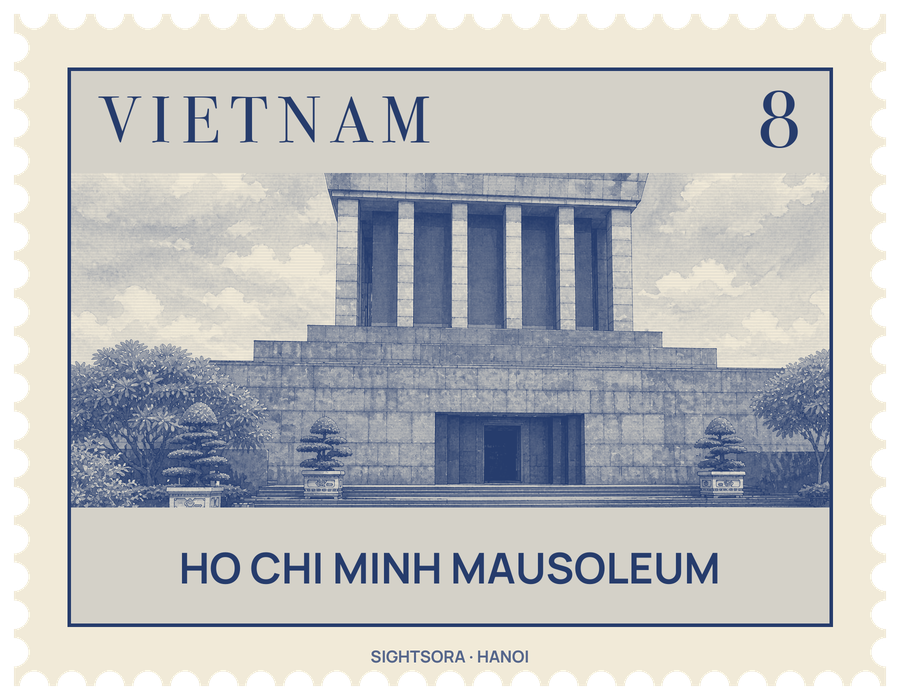
His embalmed body lies inside in a glass case, in a cool, dimly lit central hall watched over by a military honour guard. Work on the building began on 2 September 1973 and it was inaugurated on 29 August 1975.
The design takes Lenin's Mausoleum in Moscow as its model but adds Vietnamese touches such as the sloping roof. The building is 21.6 metres high, with the inscription "Chủ tịch Hồ-Chí-Minh" across the portico, picked out in dark red jade from Cao Bằng, and two platforms with seven steps on either side, used as viewing stands during parades. Two frangipani trees flank the door, 79 cycads planted in front and behind stand for the years of his life, rows of bamboo line the north and south sides, and the gardens around hold nearly 250 kinds of plants from every region of Vietnam. Two soldiers guard the entrance and change every hour.
Inside, materials came from across the country. In the front hall, pink-veined marble frames his signature in gold and the inscription saying that nothing is worth more than independence and freedom, and the doors are of precious wood sent from the south, the Central Highlands and other regions. In the marble-lined central chamber, the national and party flags on the wall are built up from 4,000 pieces of ruby quarried in Thanh Hóa. Ho Chi Minh lies in a faded khaki outfit with rubber sandals at his feet, on a bronze bed decorated with lotus patterns, inside a case made by craftsmen from Vietnam and the Soviet Union, with four soldiers standing guard around it.
From the lawns in front of the mausoleum, Bac Son Street, planted with red roses and peach trees, leads to the Martyrs' Memorial. West of the square, the Ho Chi Minh Memorial Complex groups together the Ho Chi Minh Museum and his stilt house.