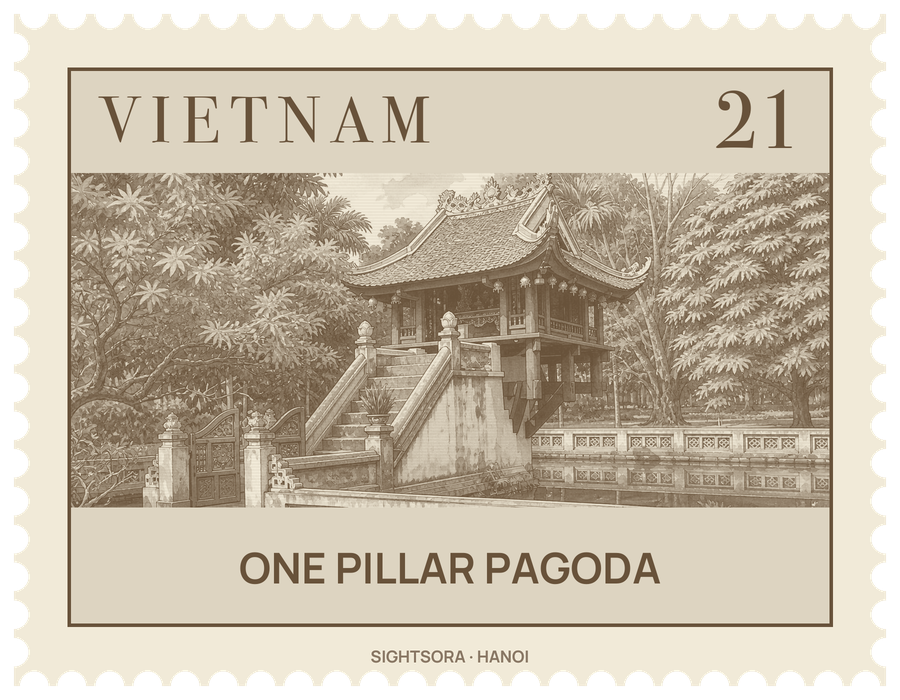
Its site is close to the Thăng Long Citadel, in the Ba Đình district at the centre of Hanoi. Strictly, this pavilion, Liên Hoa Đài or "the lotus pedestal", is the best-known part of a larger temple called Diên Hựu tự, the "pagoda of extended blessings".
The court records explain its odd shape. Emperor Lý Thái Tông, who had no son, dreamt that the Bodhisattva Avalokiteśvara, seated on a lotus, handed him a baby boy. He then married a peasant girl and a son was born, and in 1049, on the advice of a monk named Thiền Tuệ, he gave thanks by building a temple on one pillar standing in a lotus pond, as in his dream. In 1105 the temple was renovated to be finer than before, with a lake called Linh Chiểu dug around the pavilion, a gallery, a second lake named Bích Trì crossed by bridges, and a stupa in front.
Under the Lý dynasty the pagoda hosted a yearly royal ceremony for Vesak, the Buddha's birthday, when the monarch led a Buddha-bathing ceremony that drew monks and lay people alike, then released a bird. A huge bell cast for the temple in 1109 proved too heavy to hang and ended up in a field full of turtles, earning the name "bell of the turtles' field"; in 1426 the retreating Ming forces melted it down for weapons.
The Nguyễn dynasty restored and rebuilt the pagoda in 1840-1850 and again in 1922. It was dynamited in 1954, and in 1955 the Ministry of Culture of the Democratic Republic of Vietnam rebuilt the pagoda and its lotus pavilion following the Nguyễn-era design, which is the structure seen today.