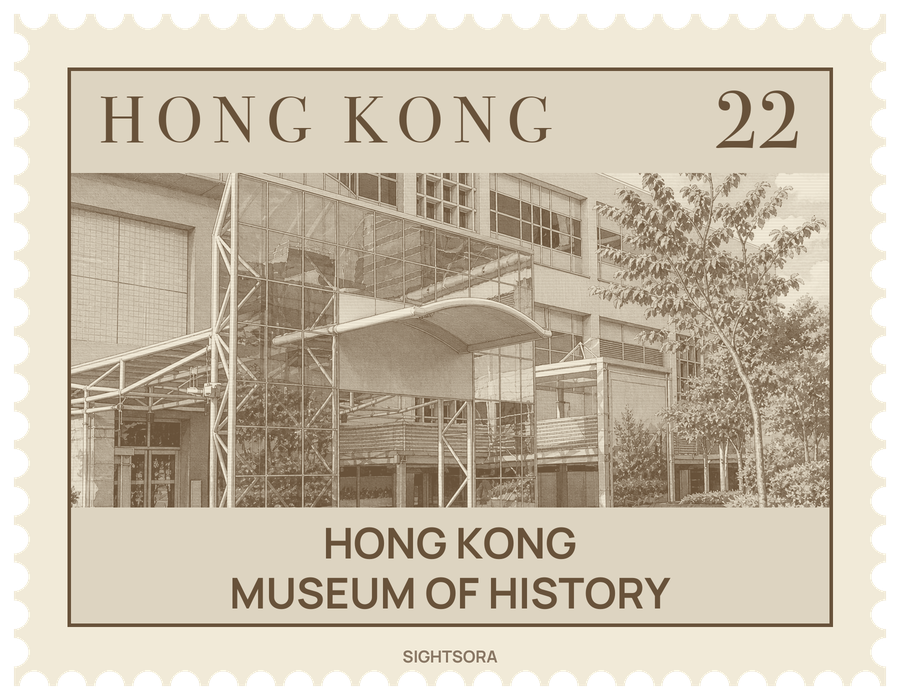
Its collections cover natural history, archaeology, ethnography and local history, as well as the way the culture of the city has developed. The museum is run by the government's Leisure and Cultural Services Department.
The museum came into being in July 1975, when the Urban Council split the City Museum and Art Gallery of 1962 into separate history and art museums. For its first years it worked from rented space in Star House; in 1983 it moved to temporary premises in Kowloon Park, and in 1998 it settled in its permanent home in Tsim Sha Tsui.
Its centrepiece is The Hong Kong Story, the main permanent exhibition since 30 August 2001. In its original form it filled eight galleries over two floors with more than 4,000 exhibits, dioramas and multimedia displays, tracing Hong Kong across 400 million years, beginning in the Devonian period and moving through folk culture and colonial history to the handover in 1997, and it drew over 10 million visitors. It closed for a thorough renovation on 19 October 2020.
The rebuilt exhibition opened on 1 April 2026 across the whole ground floor. Its ten galleries are grouped under four themes, among them "Roots of Culture" and "East meets West", with another devoted to the "Coalition against Japanese Aggression" and a last one to "Hong Kong as a Global Metropolis". Immersive historical scenes and interactive technology carry the narrative, which now continues past the 1997 handover and includes objects not shown before.
The museum also manages four smaller branch museums elsewhere in the city: the Lei Cheng Uk Han Tomb Museum (Sham Shui Po), the Law Uk Folk Museum in Chai Wan, the Fireboat Alexander Grantham Exhibition Gallery in Quarry Bay Park and, in the Mid-Levels of Central, the Dr. Sun Yat-sen Museum.
Getting there
Three MTR stations are within walking distance: Hung Hom (Exit D1), Tsim Sha Tsui (Exit B2) and East Tsim Sha Tsui (Exit P2).