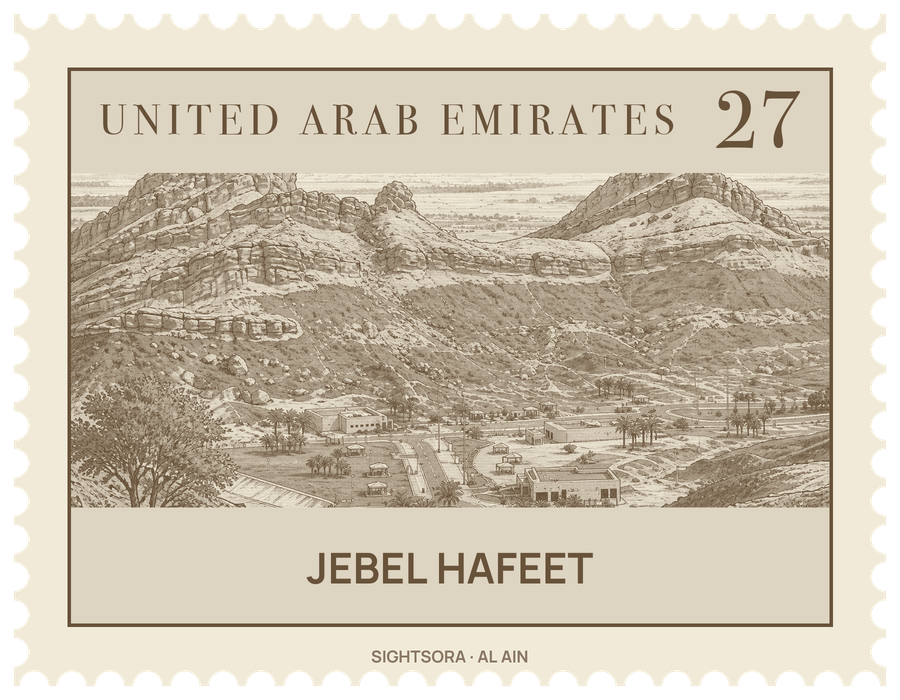
It runs for about 26 km and is 4 to 5 km wide, and it is the only mountain in the Emirate of Abu Dhabi. Its rocks were laid down in a shallow sea and are full of fossil corals, and from the top there is a wide view over Al Ain and the surrounding country. The mountain belongs to a protected area known as Jebel Hafeet National Park or Mezyad Desert Park, set up to restore its plants, animals and landscape while letting visitors learn about it.
The mountain gave its name to a stage of the Bronze Age, the Hafit period, between 3200 and 2600 BC. Near Mezyad, at its foot, 500 beehive tombs from that time have been excavated; they were first found in 1950, and Danish archaeologists working in 1959 recovered pottery and copper objects. Some graves held skeletons adorned with bronze and pearls, along with pottery from Mesopotamia and objects from ancient Iran and the Indus Valley that point to long-distance trade. The tombs on the southern side survive, while many on the north were damaged by construction. In 1993 the desert park and its tombs became part of the UNESCO World Heritage Site of the Cultural Sites of Al Ain, and the historic Mezyad Fort stands nearby.
Most visitors drive up the Jebel Hafeet Mountain Road, which Strabag of Cologne built in 1980. It winds for 11.7 km through 60 turns, with two lanes climbing and one descending, and ends at a car park beside a hotel and a palace of the country's rulers.
At the foot of the mountain, Green Mubazzarah is built around hot springs whose water, heated deep underground to around 40 °C, runs in small streams into a lake; the park also has a geyser, a children's play area, pools and chalets. Nearby is a small dam of 1955, restored in 2005 and among the early projects of Sheikh Zayed bin Sultan Al Nahyan while he governed Al Ain. Caves wind through the mountain, some holding well-preserved stalactites and stalagmites, and they shelter bats, foxes, snakes and hyraxes. Some 170 plant species have been recorded on the mountain, about 95 of them in Wadi Tarabat, its largest wadi, and a study counted 119 species of birds. The Arabian tahr lives here, and in 2019 a camera trap in the park caught an Arabian caracal.