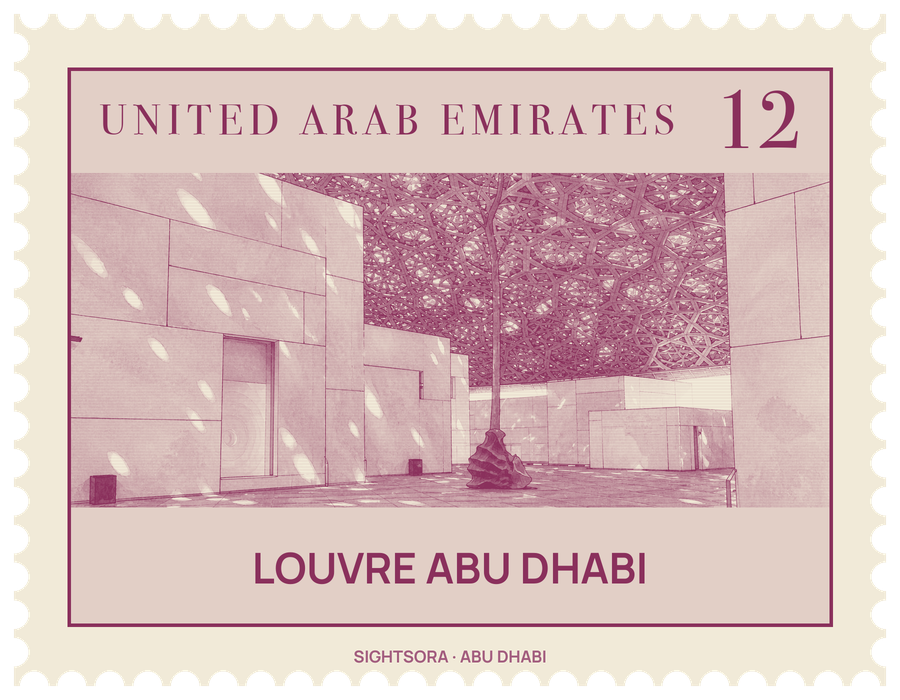
Run as a national museum of the UAE, it answers to the Abu Dhabi Department of Culture & Tourism. French President Emmanuel Macron inaugurated it on 8 November 2017 with Mohammed bin Zayed Al Nahyan and Mohammed bin Rashid Al Maktoum, and the public came in three days later.
The museum grew out of an intergovernmental agreement between France and the UAE signed in March 2007, which lends it the Louvre name until 2047 and brought art loans, special exhibitions and expert support from French museums. The architect Jean Nouvel was chosen in 2006, construction began on 26 May 2009 and the main building phase started in 2013. In November 2019, the waterfront boulevard on the eastern end of Saadiyat Island where the museum stands was named after Jacques Chirac, the former French President, to honour his role in the project.
Nouvel shaped the museum as 55 low buildings, 23 of them galleries, modelled on the low-rise homes of the region and gathered under a single dome. The dome is built from 7,850 aluminium stars of different sizes laid in eight layers, so that daylight falls through it in scattered patches meant to recall sun filtering through palm fronds in an oasis. BuroHappold's engineers gave the site a watertight basement and tidal pools between the galleries, creating the effect of a museum standing in the sea. The museum covers about 24,000 square metres, with some 8,000 square metres of galleries. Under the dome stands Giuseppe Penone's Germination, which includes Leaves of Light, a tall bronze tree, and Propagation, a porcelain panel of concentric circles based on the fingerprint of the UAE founder Zayed bin Sultan Al Nahyan.
The galleries take a chronological route across regions rather than dividing the world into separate departments. The permanent collection includes statues from ʿAin Ghazal in Jordan that are 8,000 years old, a 5th-century fibula from the Domagnano Treasure, Abel Grimmer's The Tower of Babel of 1595, Édouard Manet's Le Bohémien and Gustave Caillebotte's The Bezique Game. Among the museum's acquisitions are a sculpture of a Bactrian princess from the third millennium BC, an early Ottoman pavement and fountain set, Paul Gauguin's Breton Boys Wrestling of 1888, René Magritte's The Subjugated Reader of 1928, a 14th-century Mamluk Quran and photographs by Roger Fenton and Joseph-Philibert Girault de Prangey. The museum also runs a Children's Museum and kayaking tours around the building.