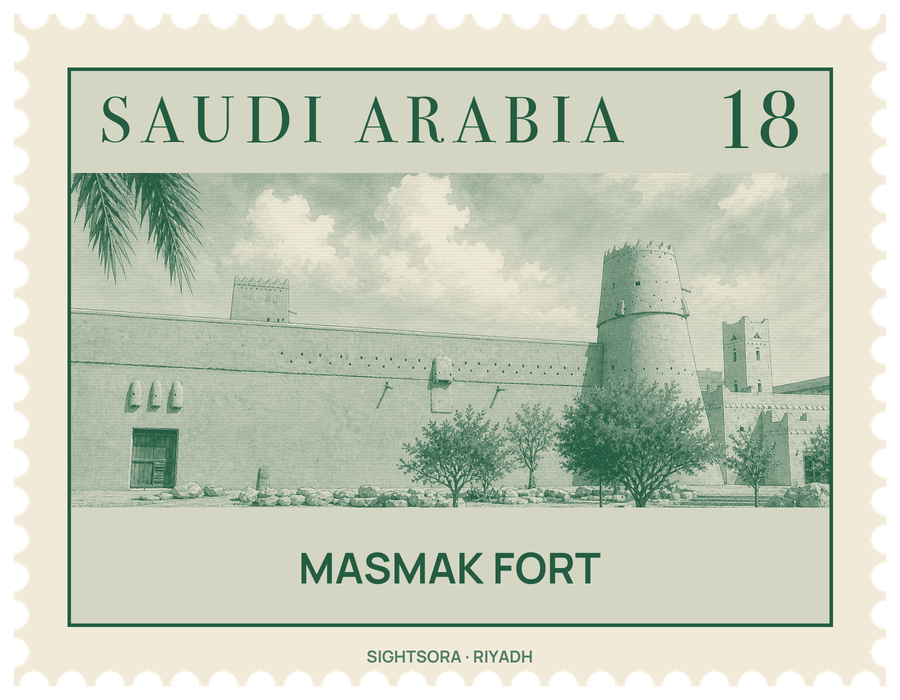
Abdullah bin Faisal Al Saud, Emir of Najd, began it in 1865, but it was finished in 1895 by the Rashidi dynasty, who had taken the town from the House of Saud. It stood on stone foundations in what was then the commercial heart of Riyadh.
The fort is remembered above all for one night in January 1902, when 'Abdulaziz ibn Saud, returning from exile in Kuwait, ambushed the garrison and recaptured Masmak from the Rashidis. That Battle of Riyadh restored Saudi rule over the town and is seen as the opening step towards the unification of Saudi Arabia. Afterwards King Abdulaziz kept munitions here until 1938, when he moved his court to the new Murabba Palace.
Restoration followed a study by the Municipality of Riyadh in 1979, and in 1995 the building opened to the public as a museum; it is now part of the King Abdulaziz Historical Centre. Inside, photographs and information panels trace the history of the kingdom, alongside old guns, costumes, farming tools and historic maps of the city.
Visitors enter through the main gate in the western wall, a palmwood door 3.6 metres high and 2.65 metres wide. Cut into its centre is al-Khokha, a small opening that lets one person through at a time without the whole gate being opened. To the left is the mosque, a large columned room with a mihrab and wall niches for copies of the Quran; straight ahead is the rectangular majlis. Both rooms are ventilated and lit by small holes in the walls.
Around the courtyard run rooms joined by columns, and stairs on the eastern side climb to the upper floor and the roofs. Three residential units open off it: one was the ruler's home, one served as the bayt al-mal, the treasury, and one housed guests. The well lies in the northeastern corner, and each of the four corner towers, about 18 metres high, is climbed by an internal staircase inside walls 1.25 metres thick.