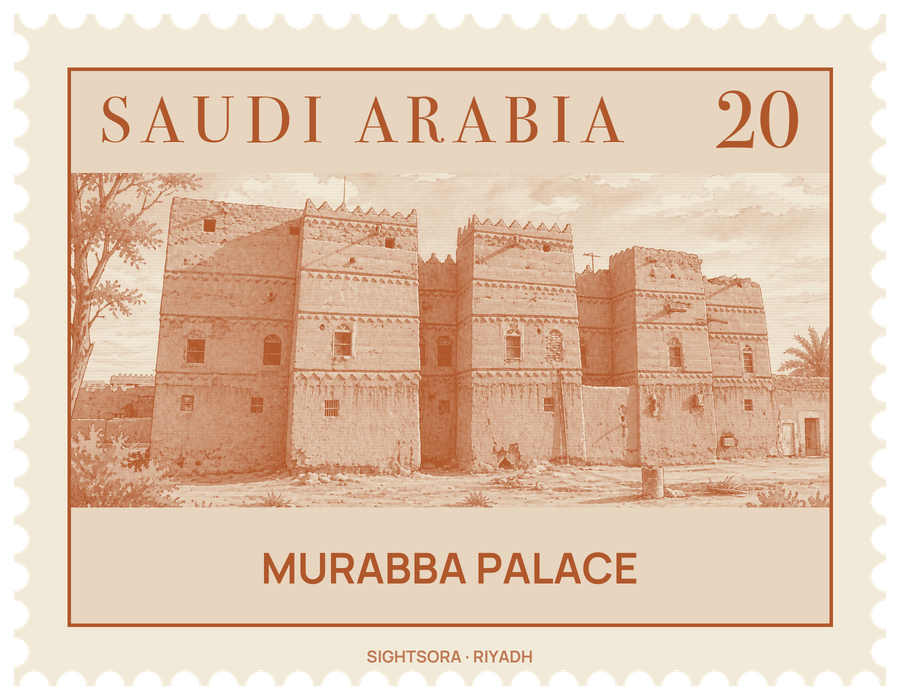
It takes its name from the 400 by 400 metre square it was laid out on, two kilometres north of the old walled city of Riyadh, and it was one of the first buildings to go up outside those walls, marking the city's first major expansion in the twentieth century. Today it is part of the King Abdulaziz Historical Center and has been open to the public as a museum since 1999.
Work began in 1936 under the builder Ibn Qabba, with the king himself closely involved; the palace was partly ready in 1938 and complete in 1945. When the king left his old court at Masmak fort for Murabba, the move brought new things to Riyadh: cars as everyday transport, electricity from generators, flushing lavatories with drains, and a concrete road linking the palace to the city centre. In 1939 Aramco technicians added lighting, fans, some air-conditioning and a central water supply, and in the late 1940s a lift was put in when advanced arthritis made the stairs difficult for the king.
The palace was the setting for official visits and the signing of agreements, and King Saud kept using it after his father; on 7 March 1954 he opened the council of ministers here with a ceremony. It lies about half a mile from Masmak fort, with gardens to the south, the Batha valley to the east and Wadi Abu Rafie to the west.
The cube-shaped complex groups residential buildings, service quarters and the king's diwan around a courtyard, within a large brick wall pierced by nine gates; it has two storeys and 32 rooms. Its style is traditional Najdi: solid masses, covered passages and inner courtyards, built from brick, local stone, tamarisk trunks and palm-leaf stalks, with straw-reinforced adobe walls carrying incised decoration. Ceilings are made of local acacia and palm-frond mats, resting on wooden beams painted with yellow, red and black geometric designs.
Restored and furnished to recall the last years of King Abdulaziz's reign, the palace is presented as a 'living museum'. The ground floor shows the guards' room and storerooms for food, coffee and firewood, while the upper floor, once the king's court with its audience hall and offices, holds salons and waiting rooms where historic garments and crafts are displayed. The building also houses the King Abdulaziz memorial hall and an archive of documents and photographs.