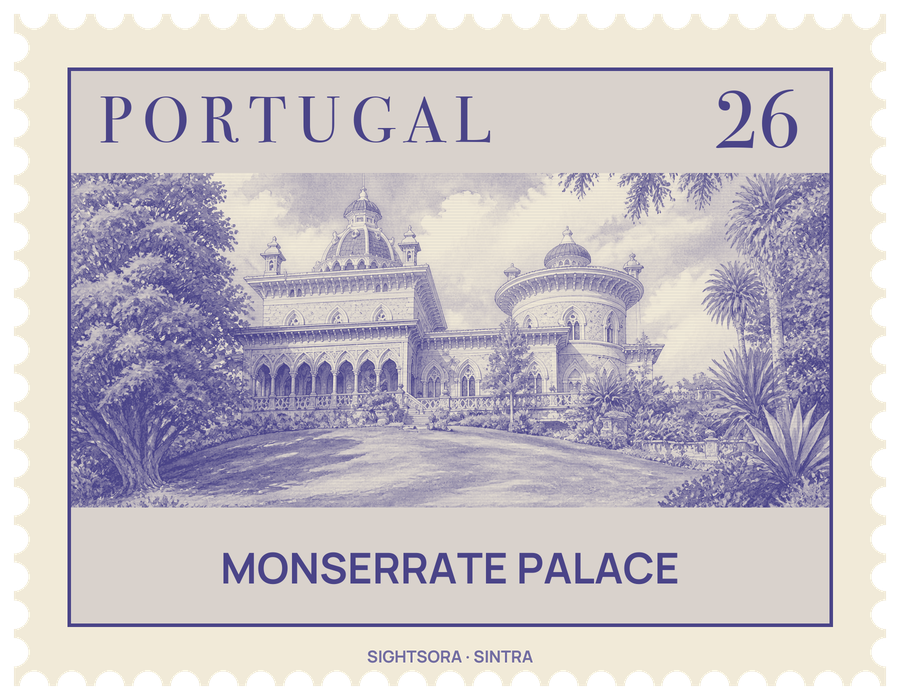
Its Islamic influences recall the centuries when the region belonged to the Muslim Gharb Al-Andalus, and it belongs to the same Sintra Romanticism as the nearby Quinta do Relógio and Pena Palace. Parques de Sintra, which runs the estate, calls it a "morada encantada", an enchanted dwelling that inspired a great English writer.
Legend tells of a chapel to the Virgin Mary raised here by Afonso Henriques once Sintra had been reconquered, and in 1540 a chapel to Our Lady of Monserrate was built on the hilltop. The farmhouse became uninhabitable after the 1755 earthquake. In 1789 the English merchant Gerard de Visme rented the land and put up a house in neo-Gothic style on top of the ruined chapel, and a few years later William Thomas Beckford began laying out a landscaped garden. Lord Byron saw the estate, still ruined, in 1809 and praised it in Childe Harold's Pilgrimage, which drew foreign travellers after him.
One of them was Francis Cook, who took over the lease in 1856, bought the property in 1863 and received the title Viscount of Monserrate from Luís I. With the architect James Knowles he rebuilt de Visme's house into the palace that stands today, and it became his family's summer home. The Portuguese state bought the palace and its hunting grounds in 1949. After Parques de Sintra took over in 2000, a recovery and restoration programme allowed the palace to open again to visitors. Inside, a fountain stands in the central hallway beneath the main dome.
The park spreads out from the palace terrace in Romantic style, with a lake, springs, fountains and grottoes. Plants are grouped by region of origin: local strawberry trees, holly and cork oaks grow alongside araucarias and palms, tree ferns from Australia and New Zealand, agaves and yuccas from Mexico, and camellias, azaleas, rhododendrons and bamboo standing for Japan. In 2013 the park won a European Garden Award in the category for developing a historic garden or park. Monserrate is part of the Sintra Mountains cultural landscape that UNESCO inscribed in 1995.
Also on the estate is the Farmyard of Monserrate, a working small farm of about 2 hectares with orchards, vegetable plots, aromatic plants and fields for horses, donkeys and sheep, as well as a picnic area and an open-air amphitheatre. It produces all its own electricity from wind, water and solar power. In the farmyard stands a 7.5-metre totem carved with a chainsaw by the Welsh artist Nansi Hemming from a diseased eucalyptus, showing the animals and plants of the Sintra Mountains, from Bonelli's eagle and the Egyptian mongoose to the fire salamander.