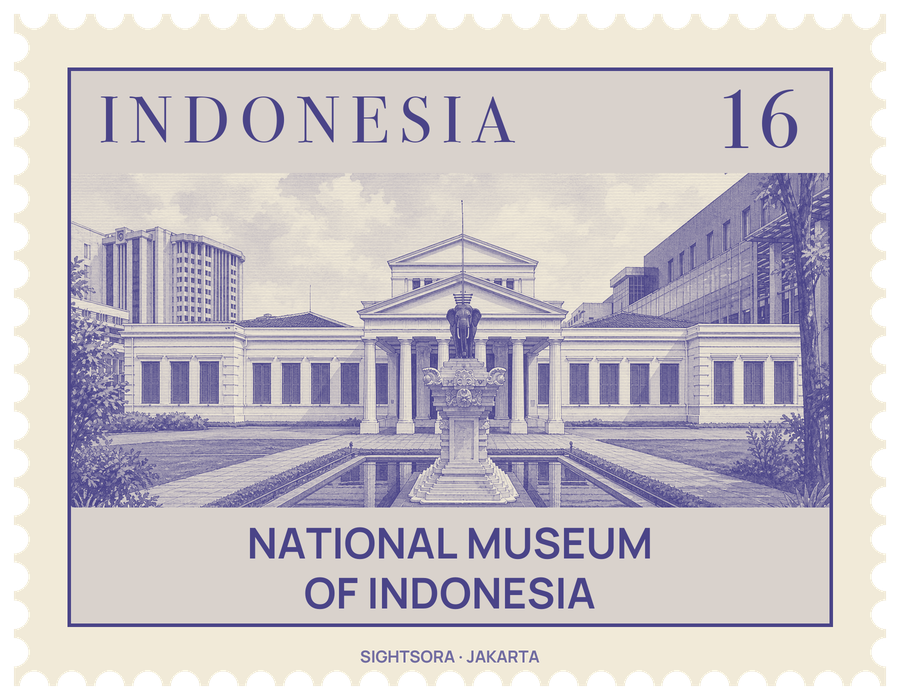
Its roughly 141,000 objects cover archaeology, history, ethnography, geography, coins and ceramics from across the archipelago. The collection grew out of the Royal Batavian Society of Arts and Sciences, founded by Dutch scholars in 1778, and the museum building opened in 1868.
Two buildings make up the museum: the colonial-era Gedung Gajah, the old wing on the south, and Gedung Arca, a four-storey new wing to the north with a neoclassical façade that mirrors the old one, opened in 2007. In the new wing, four floors of permanent exhibitions move through people and their environment, knowledge and technology, social organisation and settlement, and finally treasures and ceramics. A glass-walled bridge gallery over an outdoor amphitheatre joins the two buildings. On the night of 16 September 2023 a fire brought down the roof and back walls of part of the old wing and destroyed at least four rooms of precolonial artefacts; after renovation the doors opened again on 15 October 2024, with a show devoted to the fire itself.
The museum is best known for its Hindu-Buddhist stone sculpture from Java, Bali, Sumatra and Borneo, spanning the 5th to the 15th century. The largest piece is a statue of Adityavarman as Bhairava, more than 4 metres tall and weighing 4 tons, found in West Sumatra in 1935. Other highlights include Buddha statues from Borobudur, 9th-century statues of Ganesha, Vishnu, Shiva and Agastya from Banon Temple, a Harihara from Simping temple and a Parvati from Rimbi Temple, along with inscriptions such as Telaga Batu and Amoghapasa.
The treasure collections hold ancient Javanese gold: the statue of Prajnaparamita, the goddess of transcendental wisdom, shown wearing gold jewellery, and the Wonoboyo Hoard, a set of 9th-century gold vessels, including a bowl carved with a scene from the Ramayana, found in Klaten near Prambanan. A second treasure collection gathers royal regalia from the archipelago's kingdoms, much of it taken during Dutch military campaigns. The museum also holds the gold-inlaid kris of Prince Diponegoro, handed back by King Willem-Alexander of the Netherlands in 2020.
The ceramics range from prehistoric Buni pottery and Majapahit terracotta to Chinese wares from the Han to the Qing dynasties, built around more than five thousand pieces assembled by its first curator, van Orsoy de Flines, and later enlarged with finds from shipwrecks. The ethnography galleries are arranged by island, from the Nias and Batak of Sumatra to the Asmat and Dani of Papua, and the prehistory collection includes fossil remains of Homo erectus and Homo floresiensis, stone tools and bronze drums.