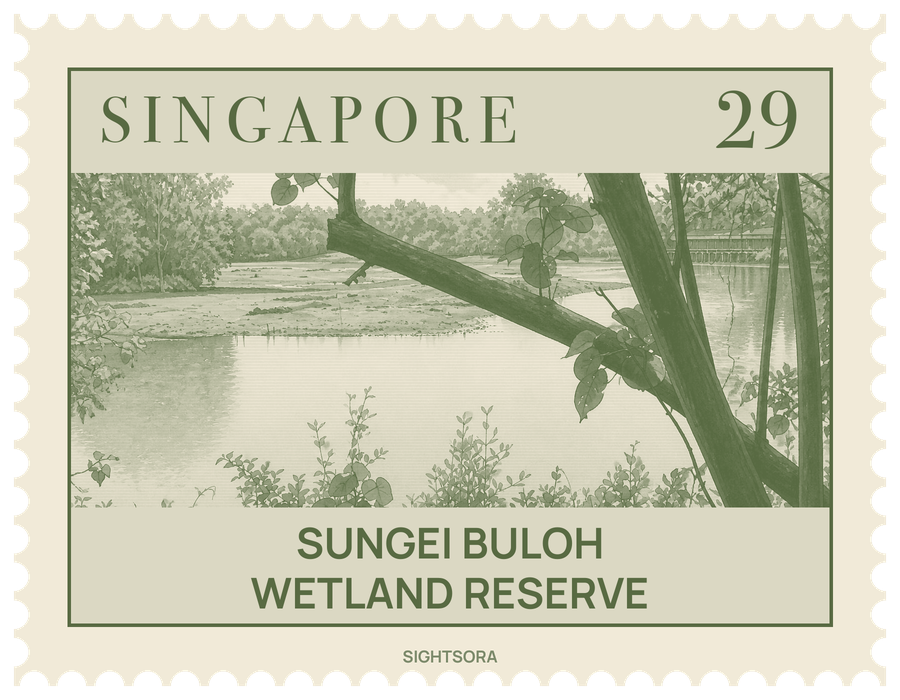
Its value to these travellers is recognised by its membership of the East Asian Australasian Shorebird Site Network, and in 2003 it was named an ASEAN Heritage Park. It was the first wetland in Singapore to be gazetted as a nature reserve, in 2002, one of four reserves alongside Labrador, Bukit Timah and the Central Catchment.
The area was little known until 1986, when the Malayan Nature Society, through its Singapore Branch, pressed for its protection because of the unusual range of birds found there. The government agreed, and in 1989 a first part of the site became a nature park, developed with advice from the Wildfowl & Wetlands Trust of the United Kingdom and the World Wide Fund for Nature. Prime Minister Goh Chok Tong opened it as Sungei Buloh Nature Park in 1993, and with its second phase the whole site gained reserve status.
Birds feeding on worms and molluscs in the mud include the Eurasian whimbrel, common greenshank and redshank, curlew and marsh sandpipers, Mongolian and Pacific golden plovers, and yellow and cinnamon bitterns. With luck, visitors may come across the resident family of smooth otters, the rare milky stork or the lesser whistling-duck. BirdLife International includes the reserve in an Important Bird Area because it supports greater crested terns, Chinese egrets and greater spotted eagles, and the atlas moth lives in the back mangrove.
Several observation hides let visitors watch birds and other animals quietly and from a distance. Saltwater crocodiles turn up from time to time, a species once common in Singapore and thought to have died out there, and snakes such as the reticulated python, the equatorial spitting cobra, the king cobra and the dog-faced water snake also live in the reserve.