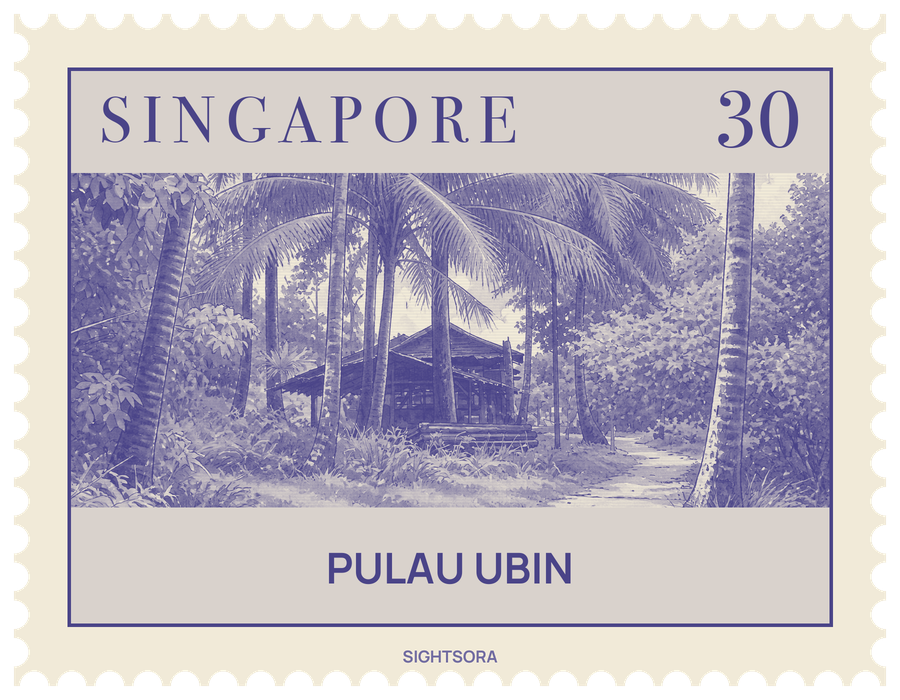
The National Parks Board manages the island, and BirdLife International counts it within an Important Bird Area for the resident and visiting birds it supports, some of them threatened. Its highest point is Bukit Puaka, the "Haunted Hill", at 75 m.
The name means "Granite Island" in Malay, and stone shaped its history. Chinese settlers had opened quarries by 1847, and Ubin granite went into the Horsburgh Lighthouse on Pedra Branca and the causeway to Johor; John Turnbull Thomson painted the grooved rock faces in 1850. Farming and fishing kept the islanders going too, and early in the 20th century coffee, tobacco and rubber were planted, with German-run coffee plantations in the 1910s; a German resident who died in 1914 is remembered at the German Girl Shrine. The quarries have since shut and are filling with water or being taken back by vegetation. A local legend explains the island's origin: a frog, a pig and an elephant raced to reach Johor, and the losers turned to stone, the elephant and pig becoming Pulau Ubin and the frog the small Pulau Sekudu.
Beside Ubin Jetty lies Ubin Town, the island's only settlement, where bicycle hire shops, provision shops and restaurants serve visitors. At its centre stands a Chinese opera stage run by Fo Shan Teng Tua Pek Kong Temple, the village temple, which is itself much visited; such stages are a feature of southern Chinese temples where opera and Getai shows are staged for the deities at major festivals.
Chek Jawa, a cape and wetland of about 100 hectares at the south-eastern tip, is the island's best-known natural area; plans to reclaim it were shelved after public appeals and a volunteer biodiversity survey in 2001. Several ecosystems meet in this one place, and its shores hold sea hares, sea squirts, octopuses, starfish, sponges, cuttlefish and nudibranchs; a boardwalk through the mangrove brings visitors close to the plants and marine life. Cyclists head for the Ketam Mountain Bike Park, built in 2007, a trail of about 8 kilometres that runs from open meadow to thick jungle with signs marking the difficulty of each stretch. The oriental pied hornbill, once lost from Singapore, has begun breeding again on the island with the help of artificial nest boxes.
Getting there
A bumboat ride of about 10 minutes links Changi Point Ferry Terminal with the island; each boat takes 12 passengers and sets off when full. The island has no public transport, so most people get around by bicycle, hired in Ubin Town, while local taxi services using small coach buses can be hired for longer trips.