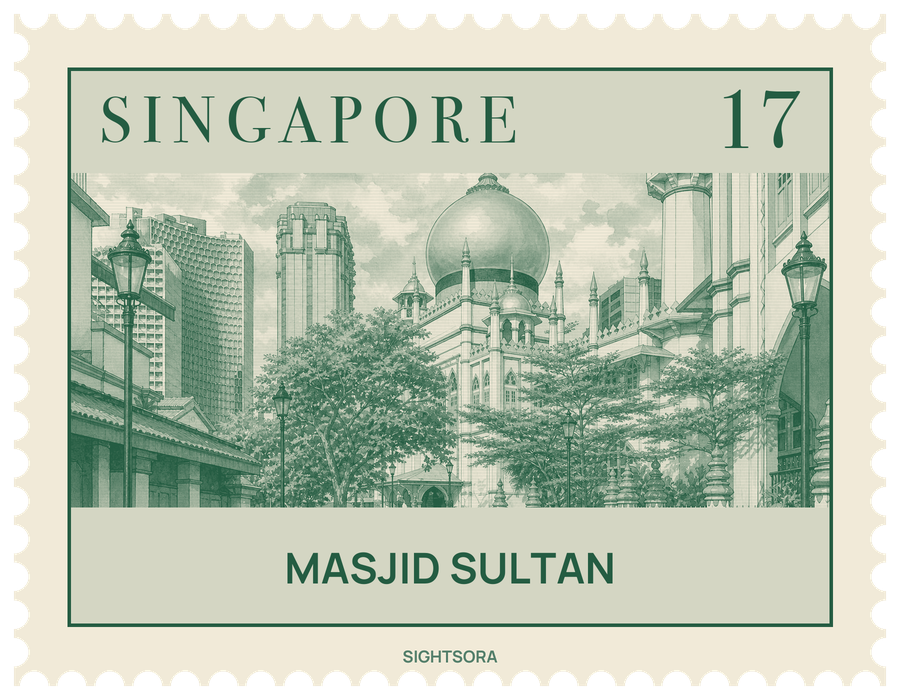
It is the district's main congregational mosque and a national monument, gazetted on 8 March 1975 for its cultural and historical value, and for Singapore's Malay-Muslim community it is an important symbol and heritage site.
The first mosque on the site was ordered in 1819 by Hussein Shah of Johor beside his palace, the Istana Kampong Glam, and finished in 1826 with money from local people and a contribution from Stamford Raffles. That building fell into disrepair, and in 1924 the mosque committee approved a larger replacement designed by the Irish architect Denis Santry of Swan & Maclaren. Between 1925 and 1931 the old mosque was taken down and rebuilt in stages, partly for lack of funds and partly so that daily prayers could go on, and the new building was completed in 1932. It was hit in a Japanese airstrike during the Second World War, and a restoration organised by MUIS, the Islamic council that has managed it since 1968, was marked complete on 16 January 2016.
The style is classical with strong Indo-Saracenic influence. The main building, holding the prayer hall and a memorial, is turned to face Mecca, so it sits at an angle to Muscat Street and North Bridge Road. At the base of both domes runs a band made from the sawn-off ends of glass bottles collected from poor families while the mosque was being rebuilt. The dome on the North Bridge Road side covers a memorial room, the Makam, whose cenotaph honours Tengku Alam Shah and his family; they were first buried in a mausoleum behind the mosque.
Small balconies capped with golden domes stand at each corner, and two eight-storey minarets rise on the eastern facade facing Muscat Street; from these minarets the adhan, the call to prayer, is still broadcast. An annexe building in the compound was opened in 1993 by Prime Minister Goh Chok Tong. Beyond prayers, the mosque hosts Qur'anic recitations, donation drives and seminars, and during Ramadan bazaars spread through the streets around it.