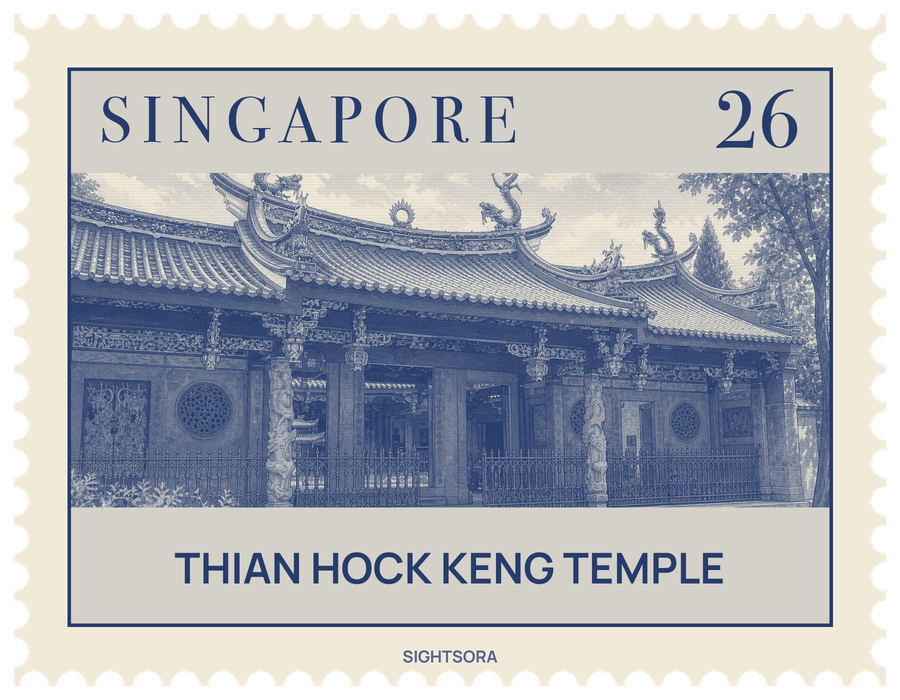
Thian Hock Keng, the 'Palace of Heavenly Happiness', replaced that makeshift shrine and still stands on the old shoreline of Telok Ayer Basin, with Al-Abrar Mosque, Telok Ayer Chinese Methodist Church and the Former Nagore Dargah as close neighbours.
Work on the permanent temple began in 1839 and took three years. Craftsmen from Fujian made the carvings and decoration, and the money came mainly from wealthy Hokkien merchants and community leaders. A granite tablet in the entrance hall lists the donors, with Tan Tock Seng, a Malaccan-born philanthropist, as the largest contributor, and the same stone shows that the founders meant the temple for Chinese of every dialect group. The statue of Mazu, brought from China, was installed in 1840 after a grand procession, and the Hokkien Huay Kuan association was formed in the temple grounds that year.
The building follows the Hokkien style, with curving roof ridges ending in upturned 'swallow tail' sweeps. Four dragons on the roofs of both front halls flank a flaming pearl, built up from small pieces of coloured ceramic in the cut-and-paste technique called jian nian. Inside, the three-hall plan of entrance hall, main hall and rear hall is lined with side halls, and the richly lacquered beams, brackets and ceilings carry dragons and phoenixes. Stone lions and painted Door Gods guard the entrance. In the main hall hangs a plaque bestowed by Emperor Guangxu in 1907, reading 'gentle waves on the southern seas'.
Mazu remains the chief deity, joined by Baosheng Dadi, God of Medicine and Health, Guansheng Dijun for spiritual protection, Confucius, much visited by students and parents, and Guanyin, the Goddess of Mercy, whose shrine sits at the back. Local Chinese Buddhists and Taoists still worship here. Beside the temple, Tan Kim Seng led the building of Chongwen Ge, Singapore's first Chinese school, in 1849, and Chong Hock Pavilion was added in 1913. A restoration between 1998 and 2000 was recognised in 2001 with an honourable mention from UNESCO's Asia-Pacific heritage conservation awards, and the temple and Chongwen Ge are protected together as a National Monument.