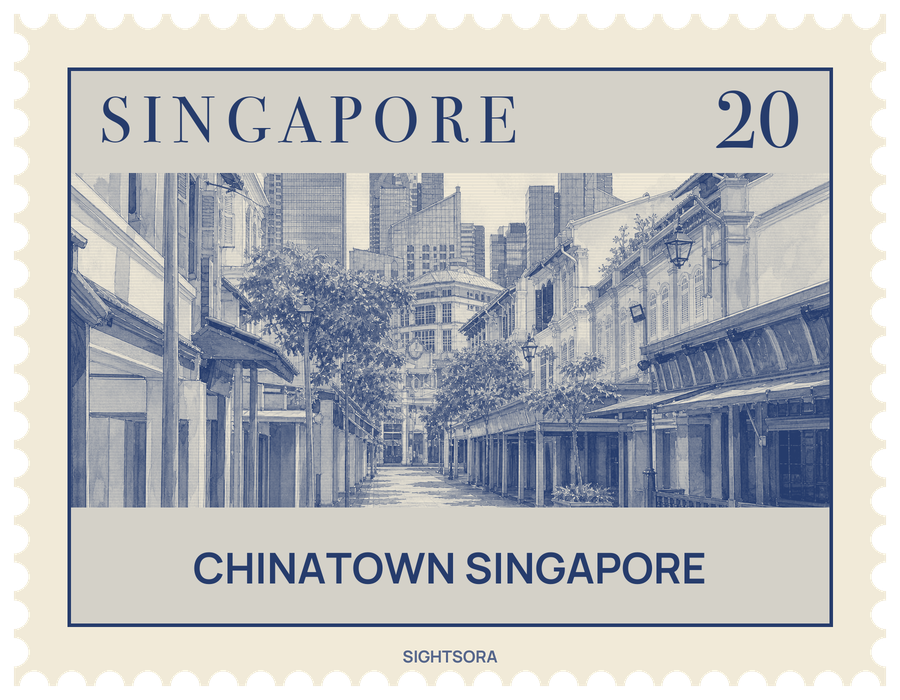
The district is made up of five precincts that grew up at different times: Telok Ayer in the 1820s, Kreta Ayer in the 1830s, Ann Siang and Club Street in the 1890s, Bukit Pasoh in the early 1900s and Tanjong Pagar in the 1920s. Its Chinese names, like the Malay Kreta Ayer, mean "bullock water-cart" or "water cart", after the animal-drawn carts that brought the area its water in the 19th century.
Under his town plan of 1822, Stamford Raffles set aside the land southwest of the river for Chinese settlers and required buildings of masonry with tiled roofs against fire, along with the continuous covered passage in front of the shops. Real building began only after plots were leased or granted from 1843, and the quarter filled with labourers, merchants and craftsmen, clan associations that supported newcomers from each dialect group, and trades such as goldsmithing, calligraphy and herbal medicine. By the late 19th century it was badly overcrowded, and from the 1960s many residents were rehoused in new estates; in 1989 the Urban Redevelopment Authority made Chinatown a Conservation Area, and shophouse facades were restored in their old styles.
Several streets carry their history in their names. Pagoda Street, now pedestrian-only, is named after the Sri Mariamman Temple at its South Bridge Road end; Sago Street and Sago Lane recall the sago factories of the 1840s, and Sago Lane was later known for its funeral businesses. Smith Street, once called "theatre street" in Cantonese after the Lai Chun Yuen opera house of 1887, now has an open-air food street and the Chinatown Complex, which houses hawker food stalls, a wet market and sundry shops. Trengganu Street, at the heart of the tourist belt, is a pedestrian mall that becomes a night market after dark.
Temples more than a century old stand among the shophouses: the Hokkien Thian Hock Keng Temple on Telok Ayer Street, the Teochew Wak Hai Cheng Bio on Phillips Street, Siang Cho Keong on Amoy Street and the Cantonese Cundhi Gong on Keong Siak Road. The quarter also has mosques built for its non-Chinese residents, the Al-Abrar Mosque on Telok Ayer Street and the Jamae Mosque on Mosque Street, completed in 1830 by Chulia Muslims from the Coromandel coast. The Chinatown Heritage Centre recreates the interiors of old shophouse homes to show how early migrants lived, and the Chinatown Heritage Trail links the main landmarks on foot.
Getting there
The MRT stops right in Chinatown: its station, served by the Downtown and North East lines, opens onto Pagoda Street in the middle of the district. Clarke Quay, Maxwell, Outram Park and Telok Ayer MRT stations are also close by, and the Kampong Bahru Bus Terminal is nearby.