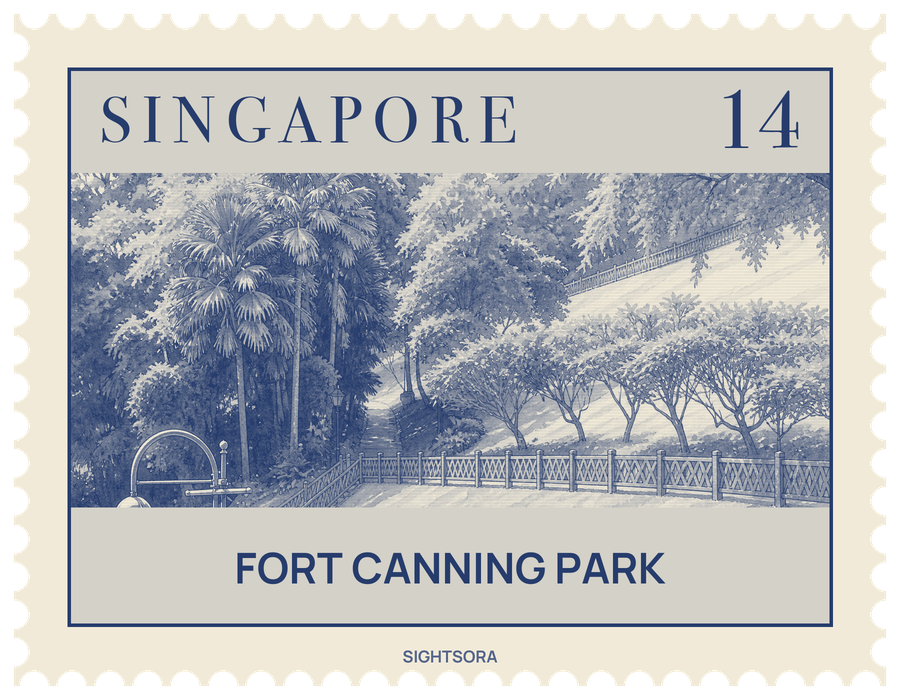
The Malays long called it Bukit Larangan, the Forbidden Hill, believing that the kings of ancient Singapore were buried here.
The hill is thought to be Ban Zu, a settlement described by the Chinese traveller Wang Dayuan around 1330. In 1928 excavation work for a reservoir turned up gold jewellery from the mid-14th century, and excavations led by John Miksic from 1984 uncovered porcelain, earthenware and the remains of glass and gold workshops, pointing to a palace of a Malay kingdom on the hill. The archaeological dig site can be seen in the park, and the Sang Nila Utama Garden, one of the historical gardens opened in 2019, recalls the Palembang prince said to have founded early Singapore, with Javanese split gates and a reflecting pool.
On 6 February 1819 William Farquhar raised the Union Jack on the hill, and Stamford Raffles later built his residence here, designed by George Drumgold Coleman; it became Government House, and the hill was known for a time as Government Hill. Raffles also started Singapore's first botanical garden on its slopes in 1822, and the Spice Garden in the park is a replica of it, with spices such as cloves and nutmeg. The old Christian burial ground of the colonial settlement is now Fort Canning Green, entered through Gothic gates built in 1846 and marked with the letters IHS; tombstones are set into the surviving walls, and cupolas designed by Coleman and the James Brooke Napier Memorial stand nearby.
In 1859 the residence was pulled down for a fort, completed in 1861 and called Fort Canning in honour of Viscount Charles John Canning, India's first Viceroy, who at the time was its Governor-General. It was demolished in 1907, and only its gateway and two nine-pound cannons remain, along with one of its sally ports, the small hidden doors through which a garrison could slip out unseen. Beneath the hill the British built an underground command centre of 30 rooms, completed in 1938, and it was here, on 15 February 1942, that the British commander, Lieutenant-General Arthur Ernest Percival, handed Singapore over to the Japanese. It reopened in 1992 as The Battle Box. The old British Army barracks now form the Fort Canning Centre, and a replica of the Fort Canning Lighthouse, first built in 1903 to guide ships through the Strait of Malacca, recalls Singapore's maritime history.
The land became a public park in stages, taking the name Fort Canning Park in 1981, and today its lawns host concerts, outdoor theatre such as Shakespeare in the Park, art festivals and open-air film screenings. Jubilee Park on the slope, opened in 2019, has a nature-themed playground with slides that follow the contours of the hill.