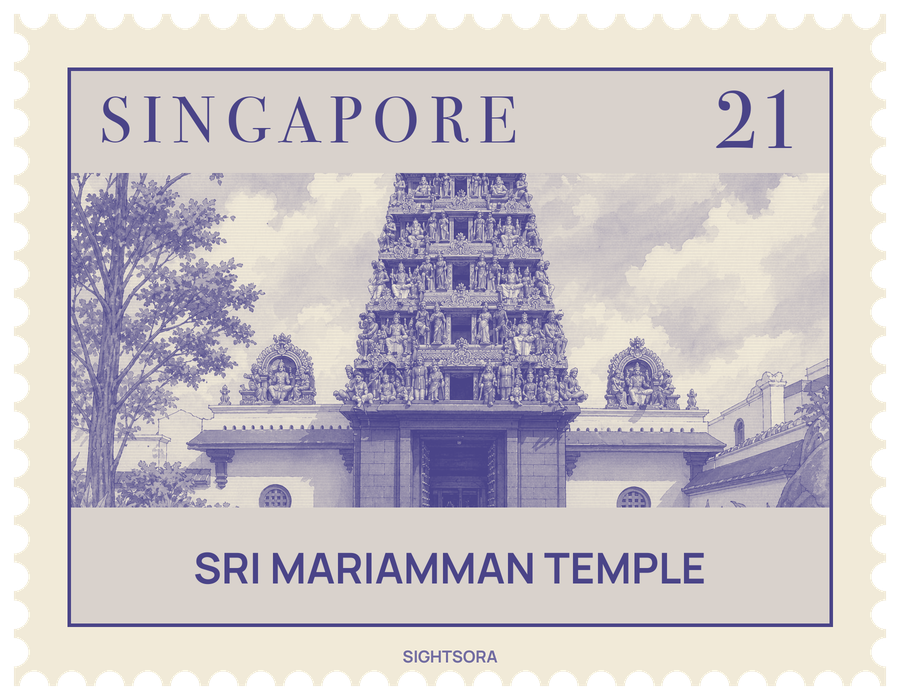
It is a Hindu temple in the Dravidian style of South India, dedicated to Mariamman, a mother goddess of rural South India who is traditionally worshipped for protection against disease. Its history and architecture led to its gazetting as a National Monument in 1973, and the two side streets running along it took their names from it: Pagoda Street and Temple Street.
The temple goes back to Naraina Pillai, a government clerk from Penang who came to Singapore with Sir Stamford Raffles in 1819 and became a leader of the Indian community. Earlier sites on Telok Ayer Street and near Stamford Canal did not work out, the first because it had no ready supply of fresh water for rituals, and in 1823 he was granted the present plot. By 1827 he had put up a modest shrine of wood and attap and installed a small image of the goddess; the Hindu Endowments Board, which manages the temple, holds that the deity in the principal shrine today is that same image. The oldest surviving brickwork dates from 1843, and much of the present building is thought to come from 1862–1863, with its plaster ornament attributed to Tamil Nadu craftsmen from Nagapattinam and Cuddalore.
Over the generations the temple did more than host worship. It gave newly arrived South Indian Tamil immigrants a roof until they found work and lodgings, and for a time its priest was the only person in Singapore allowed to solemnise Hindu marriages, so it served as the registry for them. A stone tablet still standing inside records a gift of land to the temple in 1831.
The gopuram over the main entrance replaced a slimmer three-tiered tower of 1903; the present one was raised in 1925 and given its dense covering of sculpture during repairs in the 1960s. Each tier is a little smaller than the one beneath it, a device that makes the tower look taller, and figures of Murugan and Krishna stand on either side of it. Visitors pass through huge double timber doors hung with a grid of small gold bells, which devotees ring as they go in; the doors are scaled to make a person feel small before the divine. The wall around the compound carries mouldings and figures, among them several seated cows.
A covered hall leads from the entrance to the main prayer area, where ornate columns support ceilings painted with frescoes, including a large mandala. The central shrine of Mariamman is flanked by shrines to Rama and Murugan, and around the hall stand free-standing shrines under decorated domed roofs for Durga, Ganesha and Shiva. The shrine of Draupadi ranks next in importance, with the five Pandavas of the Mahabharata beside her and Krishna presiding over them; a free-standing flagpole in the compound receives a flag a few days before major festivals.
Draupadi is at the centre of the temple's best-known event, the annual Theemithi firewalking festival, held about a week before Deepavali; an elevated viewing gallery was added partly for the crowds who come to watch. In keeping with Hindu custom, the temple is reconsecrated once every 12 years in a ritual called Kumbhabhishekham, first recorded here in 1936.