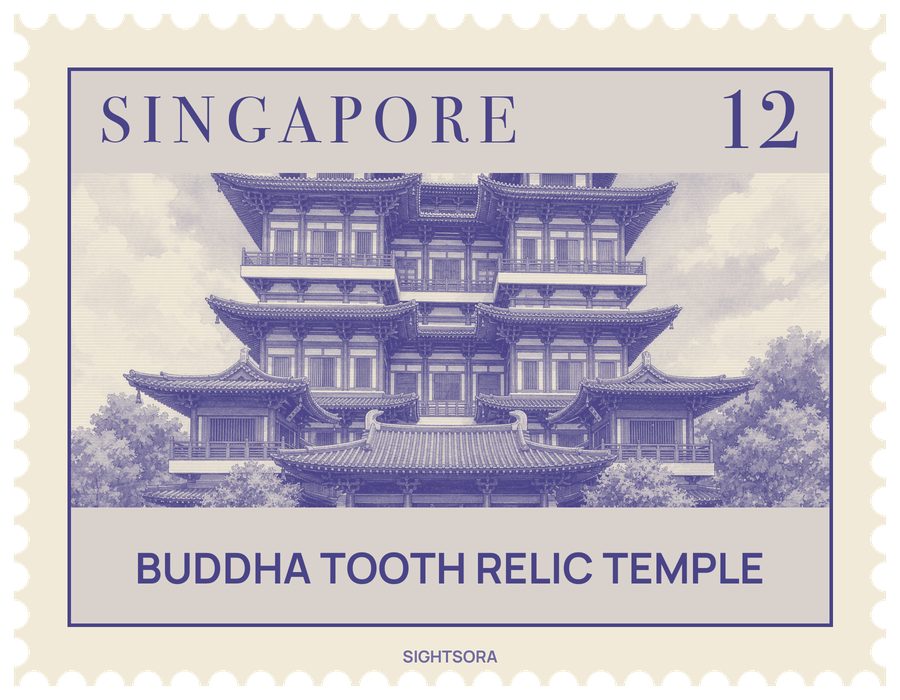
Inside, its floors climb from prayer halls with large gilded statues to a museum of Buddhist art, a gold stupa that holds the relic and a rooftop pagoda lined with thousands of small Buddha figures.
The abbot, Ven. Shi Fa Zhao, was asked by the national tourism agency, STB, to redevelop the temple in a traditional design that would serve both locals and tourists, and nine proposals were drawn up before one was chosen. He turned down a design that was too contemporary for Chinatown and also the Southern Chinese style of the district's older temples, choosing instead a Northern Chinese style shaped by Tang dynasty Buddhist architecture, with touches of Japanese and Tibetan tradition in some rooms.
The main entrance is the Shanmen, or Mountain Gate, with three heavy red lacquered doors fitted with gilt bronze studs and lion door knockers. Beyond it, the Hundred Dragon Hall rises 27 feet to hold a 15-foot statue of the Buddha Maitreya seated on a throne with each foot on a lotus. In the Universal Wisdom Hall a six-armed Guanyin sits on a lotus throne before a wall embroidered with the Heart Sutra in Siddham script. Smaller halls on the mezzanine and second floor hold a reclining Guanyin of the Southern Seas, the Bodhisattva Ksitigarbha among ancestral tablets, and Manjushri above a crouching black lion.
The third floor holds the Nagapuspa Buddhist Culture Museum, a quieter, less devotional space with 278 exhibits of sculpture, painting and textiles drawn from across Buddhist Asia, from Gandhara and India to Tibet, Japan and Myanmar, and ranging from 2nd- and 3rd-century Gandharan sculpture to modern works. Half of it tells the life of the Buddha Shakyamuni, the rest is given to Maitreya and Avalokiteshvara, and a side chamber shows tiny pearl-like relics with reliquaries and small stupas. On the same floor, a statue of Samantabhadra with 20 arms sits above a throne of four elephants.
The tooth relic is kept on the fourth floor in the Sacred Light Chamber, where the floor is laid with gold tiles and the walls are painted with the Twenty Devas. It rests in a stupa set with 189 sets of gemstones, with a solid gold statue of Maitreya at its centre, eight gold panels showing scenes from the life of the Buddha around its base, and pillars modelled on those of King Ashoka at the corners. On the roof, the Ten Thousand Buddha Pagoda holds about 11,111 small gilt Buddhas and Bodhisattvas around a large prayer wheel of the Vairocana Buddha, while pavilions on each side enshrine the Five Tathagatas.