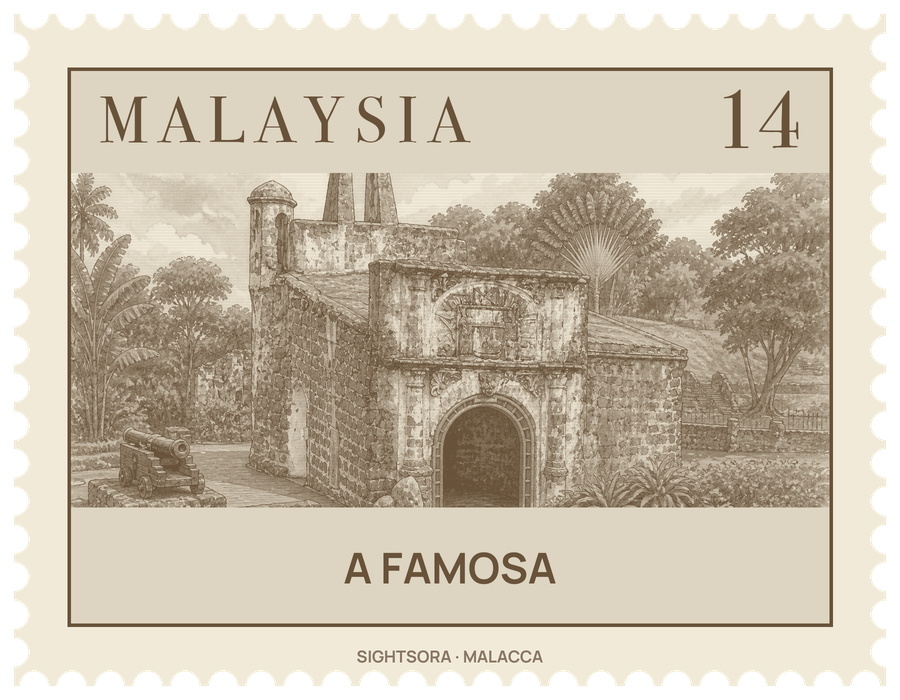
The name first belonged to the fort's keep, a tower some 60 metres tall, and then spread to the whole fortress. In Portuguese the opening "a" is an article, pronounced "uh", not the letter A.
Afonso de Albuquerque's fleet took Malacca from its sultanate in 1511, and he had the fort built around a natural hill by the sea, so that the port could anchor Portugal's route to the spice trade and to China. Hundreds of slaves did the work, partly with rubble from the city's destroyed mosques and tombs. Within long ramparts and four major towers stood an ammunition store, the captain's residence, officers' quarters and town houses, and extensions were added around 1586 as the population outgrew it.
The Dutch drove the Portuguese out in 1641, pulled down the keep and enlarged the outer walls. They renovated the gate in 1670: the inscription "ANNO 1670" is carved on its arch, and above it is a relief of the emblem of the Dutch East India Company. When the British took over Malacca from the Dutch, they ordered the fortress demolished, and it was razed almost completely, but the Santiago Gate was spared along with the Stadthuys, the church and the jail.
Other fragments have since resurfaced. In 2004 the remains of a watchtower called the Santiago Bastion came to light during building work at Dataran Pahlawan, and in November 2006 the foundations of what is believed to be the Dutch-built Middelburg Bastion were uncovered while a revolving tower was being built in Malacca Town; the bastion was restored in 2006–2007, and the tower was moved to another site.