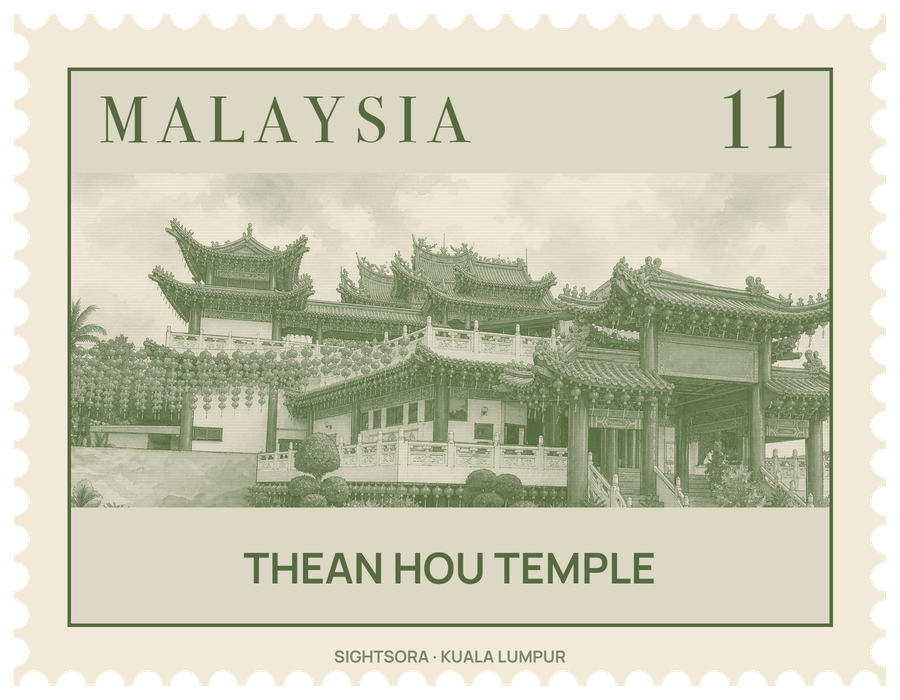
The Thean Hou Temple is dedicated to Mazu, the Chinese goddess of the sea, here called Tian Hou, and it mixes elements of Buddhism, Confucianism and Taoism. It was built between 1981 and 1987 by Malaysia's Hainanese community, who paid for it partly by buying columns and beams, and it opened officially on 3 September 1989. The Selangor and Federal Territory Hainan Association owns and runs it.
Visitors pass through a multi-arched gateway with red pillars, red standing for prosperity and good fortune. The lower levels hold souvenir stalls and a canteen, a multi-purpose hall and offices, and the prayer hall sits at the top. Inside are three altars, each with a large statue: Guan Yin, the Goddess of Mercy, on the right, Tian Hou in the centre and on the left Shui Wei Sheng Niang, goddess of the waterfront. Between the altars stand two pairs of Kau Cim oracles, fortune sticks that visitors can use.
Guan Yin appears again outside. To the right of the prayer hall a smaller statue of her stands among rocks and falling water, where people kneel to receive a blessing of water, and a larger one in the same setting greets visitors at the entrance to the grounds. Around the temple are a Chinese medicinal herb garden, a wishing well and a tortoise pond, a large statue of the goddess facing the temple and figures of the twelve animals of the Chinese zodiac. A statue of Yue Lao, the deity of matchmaking, draws couples hoping for love and marriage; the temple also registers marriages.
The temple celebrates the birthdays of its three goddesses, holds Buddhist chanting and Wesak Day, and marks Chinese New Year and the Mid-Autumn Festival in the eighth lunar month. Classes in qigong, tai chi and wushu take place in the compound.
Getting there
The temple stands on Lorong Bellamy and is reached by road from Persiaran Endah, which joins Jalan Robson to the north; the climb is very steep for cars and minivans.