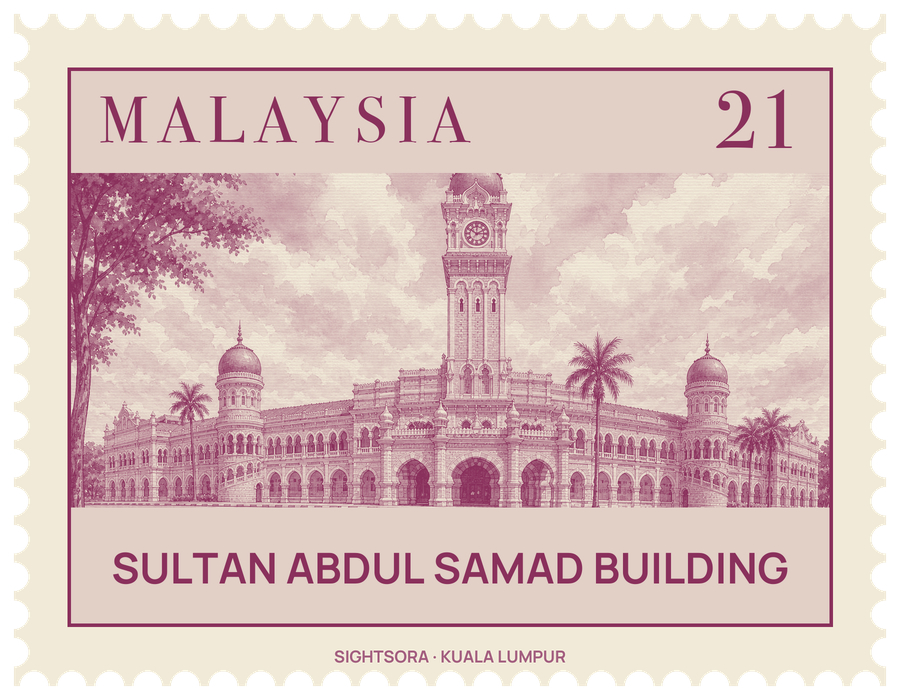
Completed in 1897, it was built to house the colonial government, and early maps call it simply the Government Offices. Its colouring has given the style a nickname, "blood and bandages".
The design mixes Mughal, Moorish and Gothic influences, a British Raj style chosen, as the building's present custodians explain, to appeal to Selangor's Muslim ruler while also displaying imperial prestige. A.C. Norman drew the first plan in a Classical Renaissance manner; the State Engineer, Charles Edwin Spooner, disliked it, and R. A. J. Bidwell reworked the elevations under his direction, with contributions from A. B. Hubback. Norman's floor plan, shaped roughly like the letter F, survived. The façade runs for 137.2 metres, both floors have verandas 3.5 metres wide, and two lower towers with staircases flank the clock tower, whose design echoes Big Ben.
Building began in September 1894 and used some 4 million bricks, many made in a factory Spooner set up in Brickfields. Sir Frank Swettenham opened the offices on 4 April 1897 with a ball, for which the exterior was lit by gas burners, and the clock first chimed in June 1897 for Queen Victoria's Jubilee Parade. The clock, by Gillett & Johnston of Croydon, has a bell of one ton that strikes on the hour and the half hour. Spires on the main tower were taken down in 1939 as an air-raid precaution and put back in 2026.
The open ground in front, renamed Dataran Merdeka on 1 January 1990, is where the Union Jack came down at midnight on 30 August 1957 and the flag of Malaya was raised for the first time; a flat black marble plaque at the foot of a 95-metre flagpole marks the spot. The building took the name of Sultan Abdul Samad in 1974, after Kuala Lumpur became a Federal Territory, and from 1978 it housed the country's superior courts until they moved out in 2003 and 2007. Behind it, the Jamek Mosque stands where the Klang and Gombak rivers meet, built in a similar style.
Restored by Khazanah Nasional Berhad under the Warisan KL initiative, with its first block opened again to visitors on 2 February 2026, the building heads a complex of six heritage buildings with galleries, cafés and event spaces. Two galleries are inside: the Royal Selangor Gallery tells the story of the city's pewter craft through exhibitions, workshops and public art, and the Kuala Lumpur City Gallery follows the city from the 1820s through a series of rooms such as the Hikayat Chamber and the Confluence, Visionary and Harmony halls.
Getting there
The building is a short walk west of Masjid Jamek LRT Station.