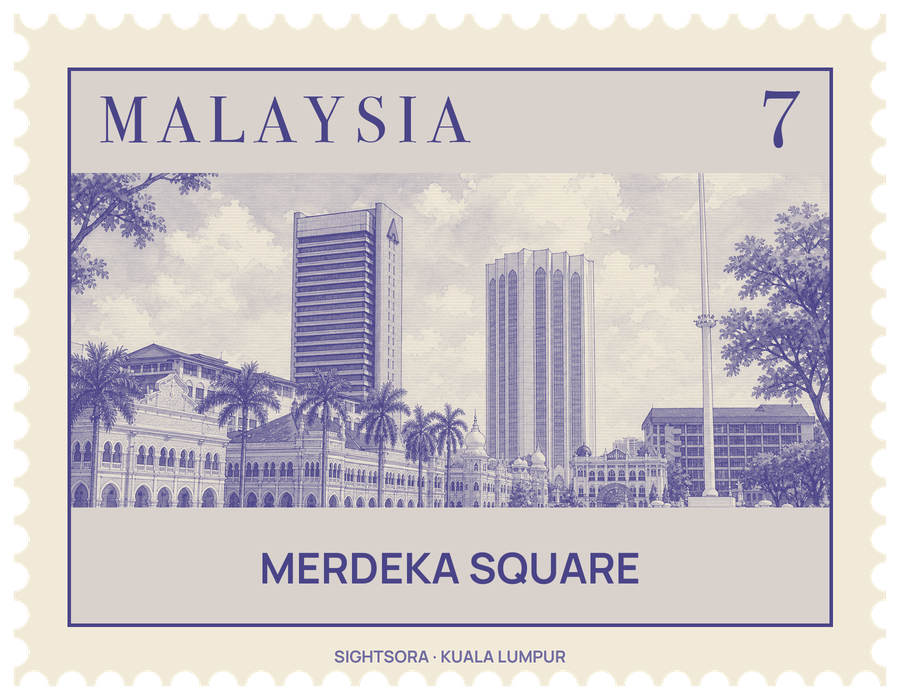
The spot is marked by a round, flat plaque of black marble, and a 95-metre flagpole at the square's southern end now flies the national flag. The square is still the usual setting for the yearly Independence Day Parade.
Before it was a national monument it was the Padang, the field, a patch of swampy ground west of the Klang River that the British drained in the 1880s as a police parade ground. Ernest Birch, the acting British Resident and a keen cricketer, had it smoothed in 1892, and for nearly a century it served as the cricket and rugby ground of the Selangor Club. In 1987 City Hall took it back and turned it into a historical park with touches borrowed from Trafalgar Square in London; Mahathir Mohamad opened it on 31 December 1989.
The buildings around the square are the best reason to linger. On one side stands the Sultan Abdul Samad Building of 1897, an arched and domed building in the Indo-Saracenic style by the architects Norman, Bidwell and Hubback, which first held the government offices of Selangor. Facing it across the grass is the Royal Selangor Club, set up in 1884 to bring together senior figures of British colonial society. St. Mary's Anglican Cathedral, built in 1895, stands to the north.
To the south, next to the old Standard Chartered Bank building, the Kuala Lumpur City Gallery tells the story of the city through miniature models and a large city model show. Near the flagpole, at a corner of the square, is the Cop's Fountain, built in 1897 in memory of Steve Harper, a well-liked police inspector. A short distance away stands the original Kuala Lumpur Railway Station, still in use for trains.
Getting there
The square is a short walk west of Masjid Jamek LRT Station.