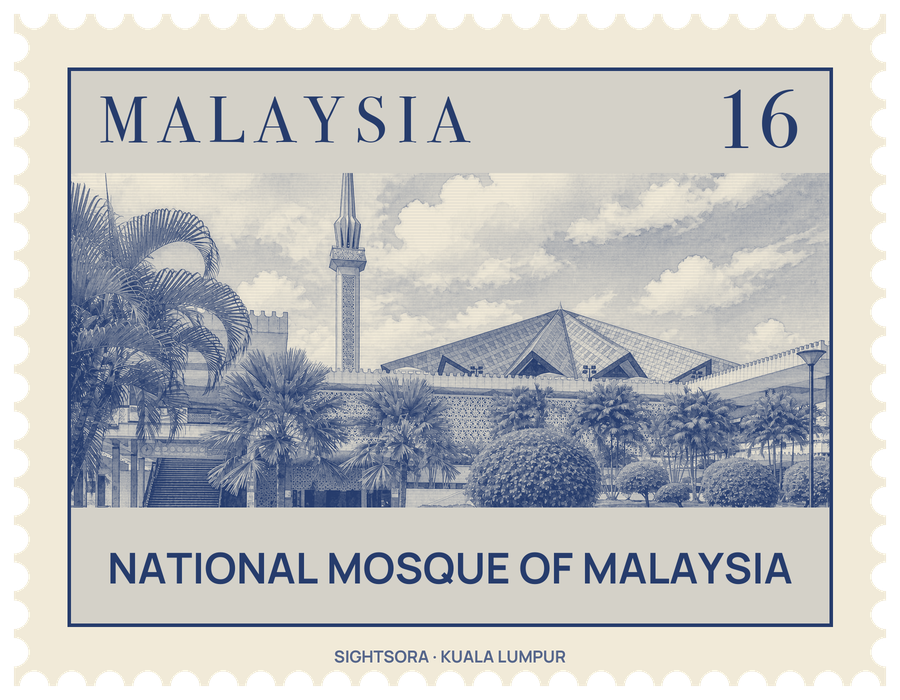
The design plays on the umbrella, an everyday object of the tropics: the main roof reads as one opened out, the cap of the minaret as one closed. The prayer hall holds 15,000 people, and reflecting pools and fountains run through the grounds around it.
The mosque was conceived as a monument to independence. Malaya became independent on 31 August 1957, and a month earlier the Federal Executive Council had already raised the idea of a national mosque. The chief ministers proposed naming it after Prime Minister Tunku Abdul Rahman, but he declined and chose the name Masjid Negara instead, as thanks for an independence won without bloodshed. The foundation stone was laid on 27 February 1963, and on 27 August 1965 the third Yang di-Pertuan Agong, Tuanku Syed Putra of Perlis, opened the building.
Three architects of the Public Works Department, Baharuddin Abu Kassim at their head with Ikmal Hisham Albakri and Howard Ashley, drew up the original design, and Antony Morris was the engineer in charge of construction. Their reinforced concrete building was a deliberately modern statement for a young country, with traditional Islamic calligraphy and ornament reinterpreted in a contemporary way. The folded plates of the roof were also a structural answer, letting the concrete span the wide main hall. The roof was first pink; since a major renovation in 1987 it has been clad in green and blue tiles.
Beside the mosque is the Makam Pahlawan, or Heroes' Mausoleum, where several Malaysian Muslim leaders are buried under a concrete roof in the form of a seven-pointed star, echoing the mosque's own. The mosque and mausoleum were declared a heritage site in 2007 and raised to national heritage status in November 2012. In 2015 the mosque marked its fiftieth anniversary.
Getting there
The mosque is on Jalan Sultan Hishamuddin, a short walk from Kuala Lumpur railway station, with an underground passage leading towards it. KTM ETS trains call at the station, as do two KTM Komuter lines, Batu Caves-Pulau Sebang and Tanjung Malim-Port Klang. A link from the station leads to Pasar Seni, where the MRT Kajang and LRT Kelana Jaya lines call. There is also a Masjid Negara stop on the Red Line of the Go KL City Bus.